


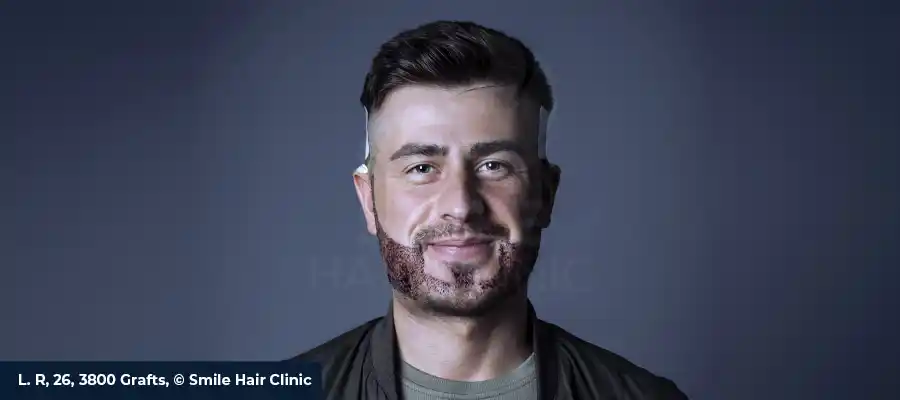
A beard transplant in Turkey moves hair follicles from the back of your scalp into the cheeks, jawline, chin or moustache area to fill patchy spots, build density or create a beard where one never fully grew. It is done under local anesthesia in a single day, most patients stay in Istanbul for three days, and the new beard reaches its final density around 12 months later. Typical prices in Turkey range from about $1,800 for partial work to $4,800 for a full beard.
I am Dr. Mehmet Erdoğan, co-founder of Smile Hair Clinic in Istanbul and an associate member of the International Society of Hair Restoration Surgery (ISHRS). Facial hair work is some of the most detailed surgery we do, because every graft sits in plain view on the face. This page explains how a beard transplant is planned and performed, what recovery looks like week by week, what it costs and how to judge whether it is right for you.
| Beard transplant in Turkey at a glance | What to expect |
|---|---|
| Technique | FUE extraction with sapphire FUE or DHI implantation |
| Donor area | Back of the scalp, sometimes under the chin |
| Typical graft count | 1,000 to 3,500, depending on the area |
| Anesthesia | Local anesthesia, you stay awake |
| Operation time | About 4 to 8 hours |
| Stay in Istanbul | Usually 3 days |
| Return to office work | 3 to 5 days |
| First shave with a razor | Around week 4 |
| Final result | About 12 months |
| Typical market price | $1,800 to $4,800 |
What Is a Beard Transplant?

A beard transplant is a facial hair restoration procedure in which individual follicles are taken from a donor area, usually the back of the scalp, and implanted one by one into the parts of the face where beard growth is thin or missing. Because the follicles are your own, there is no rejection, and once they settle they grow and can be shaved, trimmed and styled like the rest of your beard.
The surgery itself is the same family of techniques used for scalp hair, but the design is completely different. Beard hairs grow at very low angles, change direction across the cheek, jaw and neck, and sit in a pattern that has to match your face. Getting those angles right is what separates a natural beard from one that looks planted.
Who Is a Good Candidate for a Beard Transplant?
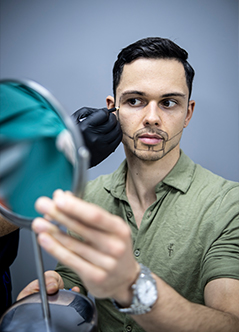
A good candidate is a healthy adult whose beard is patchy, uneven or absent in certain areas, and who has a donor area at the back of the scalp dense enough to supply the grafts needed. Most of my beard patients fall into one of a few groups.
Some have never grown more than a sparse beard because of genetics. Others have one or two bald patches on the cheeks or around the chin that break up an otherwise full beard. Scars from acne, accidents, burns or previous surgery are also common reasons, since hair can be implanted into stable scar tissue to camouflage it. Transgender men who want fuller, more masculine facial hair are good candidates too, ideally once hormone therapy has had time to show what natural growth it will produce.
A beard transplant is not the first step for everyone. Very young men whose facial hair is still filling in may simply need time. Active alopecia areata in the beard needs to be controlled first, because transplanted hair can be lost in a flare. If both the scalp and the face need hair, the donor area has to be shared carefully between the two, which is covered further down this page.
How Many Grafts Does a Beard Transplant Need?
Most beard transplants use between 1,000 and 3,500 grafts. The number depends on which zones are treated, how much existing hair there is and how dense you want the final beard to be. The ranges below are typical planning figures I use during consultation.
| Area treated | Typical graft range |
|---|---|
| Moustache only | 300 to 600 |
| Goatee or chin | 400 to 900 |
| Cheeks and jawline | 800 to 1,600 |
| Full beard transformation | 2,000 to 3,500 |
Beard grafts are mostly single hairs, placed close together and at sharp angles, so the same graft count looks denser on the face than it would on the scalp. This patient received 2,400 grafts and documented his beard over a full year.
How Is a Beard Transplant Performed?
A beard transplant is performed in four stages on a single day, with planning, extraction, channel opening and implantation, all under local anesthesia. The most important part happens before any graft is taken.
Planning starts with your face, not with a number. We draw the cheek line, the neckline and the moustache borders directly on your skin and adjust them until they suit your jaw and your style, whether that is a short stubble look, a defined beard or a full one. Once the design is agreed, grafts are extracted from the donor area with a fine punch and kept in a cooled preservation solution. Recipient channels are then opened at the angle and direction of your natural beard growth, and the grafts are implanted one by one. Dr. Firdavs Ahmedov, our head doctor, walks through each of these steps in the short video below.
Which Technique Is Used for a Beard Transplant?
Both main techniques extract grafts the same way, with FUE, and differ in how the grafts are placed. In most beards I combine them, using each where it works best.
| Technique | How grafts are placed | Where it works best |
|---|---|---|
| Sapphire FUE | Fine channels are opened with sapphire blades, then grafts are placed into them | Larger areas such as the cheeks and full beard coverage |
| DHI | Each graft is loaded into a Choi implanter pen and placed directly | Borders, the moustache, the goatee and filling between existing hair |
Where Do the Grafts for a Beard Transplant Come From?
The grafts usually come from the back of the scalp, where hair is permanent and its thickness is closest to beard hair. When the scalp donor area needs to be saved for a future hair transplant, hair from under the chin can sometimes be used as well. The scalp donor area heals within days and the extraction points are hidden once the hair grows back.
What Happens During Your Stay in Istanbul?
Most patients stay three days. On the first day you meet your doctor in person, the beard is designed and blood tests are done. The operation takes place on the second day. On the third day your face and donor area are checked, you have your first wash at the clinic and you receive your aftercare instructions before flying home. Airport transfers, the hotel and an interpreter are arranged before you arrive.
This patient filmed his whole stay, from the consultation and the operation to his first wash and his thoughts afterwards.
What Does Recovery Look Like After a Beard Transplant?
Recovery is quick and mostly cosmetic. Redness and mild swelling settle within the first few days, tiny crusts around each graft fall off by around day 10, and most people go back to office work within three to five days. The transplanted hairs then shed before regrowing from month three onward.
| Time after surgery | What you will notice |
|---|---|
| Days 1 to 3 | Tightness, redness and mild swelling, first wash at the clinic |
| Days 4 to 10 | Small crusts form and fall away, the face looks presentable again |
| Weeks 2 to 6 | Transplanted hairs shed while the follicles stay in place |
| Months 3 to 5 | First fine hairs appear |
| Months 6 to 9 | Density and direction improve clearly |
| Month 12 | Final shape and density, the moustache can keep maturing a little longer |
Two brothers who had their beard transplants together filmed their 13-day update, including how they wash the area at home.
When Can You Shave After a Beard Transplant?
You can trim lightly with scissors or a clipper after about 10 to 14 days, once the crusts are gone. A razor should wait until around week four, when the grafts are firmly anchored and the skin has fully settled. Until then, avoid rubbing the face, strong skincare products and direct sun on the treated area.
Is a Beard Transplant Permanent and Does It Look Natural?
Yes, transplanted beard hair is permanent. The follicles come from an area of the scalp that keeps growing throughout life, and they keep that quality after they are moved to the face. You can shave, trim and grow the new beard like natural facial hair.
Whether it looks natural depends almost entirely on design and placement. Grafts have to lie almost flat against the skin, follow the changing direction of beard growth across the face and blend softly at the borders rather than ending in a hard line. Scalp hair can be slightly softer than original beard hair, but once the beard grows to its normal length the difference is very hard to see. The 12-month result below shows a large beard restoration of 4,100 grafts.
Can You Have a Beard and Hair Transplant at the Same Time?
Yes, a beard and hair transplant can be done in the same session when the donor area can safely supply both. This is the decision I spend the most time on during consultation, because grafts used for the beard are grafts no longer available for the scalp. In younger men whose hair loss is still progressing, I often prioritize the scalp or stage the two procedures.
When it is planned well, a combined operation saves a second trip and lets the hairline and the beard be designed together, so the whole face looks balanced. These patients had both areas treated in one visit.
If you are considering scalp surgery as well, the hair transplant in Turkey page explains how the hairline, graft count and donor planning work. Other facial areas can be treated in the same visit, including a moustache transplant, sideburn transplantation to connect the beard to the hairline, or an eyebrow transplant.
How Much Does a Beard Transplant Cost in Turkey?
A beard transplant in Turkey typically costs between $1,800 and $4,800. Partial work such as the moustache, goatee or a few patches usually sits at the lower end, from about $1,800 to $2,700, while a full beard transformation generally costs $2,700 to $4,800. The same procedure in the United States or the United Kingdom usually costs several times more.
How packages, travel and other procedures add up is explained on the hair transplant cost in Turkey page.
| Type of beard work | Typical price in Turkey |
|---|---|
| Partial work (moustache, goatee, patches) | $1,800 to $2,700 |
| Full beard transformation | $2,700 to $4,800 |
The final price depends on the zones treated, the graft count, the technique and whether other areas are combined in the same operation. Beard transplants are priced individually after an online assessment of your photos, and the quote is all-inclusive, covering the operation, medications, hotel, VIP transfers, an interpreter and aftercare follow-up. To receive a quote for your own beard, send a few clear photos of your face and donor area through the contact page.
What Are the Risks of a Beard Transplant?
A beard transplant is a low-risk procedure when it is done by an experienced doctor in a licensed, sterile facility. The usual side effects are temporary redness, swelling around the cheeks and jaw for a few days, small crusts and some numbness, all of which settle on their own.
Less common problems include ingrown hairs, small bumps similar to folliculitis and, rarely, infection, which is why following the washing routine and using the prescribed products matters. The risks that cannot easily be undone are design errors, such as an unnatural border or hairs growing at the wrong angle, and overharvesting of the donor area. Both come down to who plans and performs the operation, so ask who will design your beard and who will open the channels before you book. You can read more about my background on the about me page.
What Do Patients Say About Their Beard Transplant?
The clearest way to understand the result is to watch it develop on someone else’s face. These two videos follow a large beard and hair transformation of 5,000 grafts, from planning to the final result.
Frequently Asked Questions About Beard Transplant in Turkey
Does a beard transplant hurt?
Only the local anesthetic injections at the start cause brief stinging. After that the face and donor area are numb for the rest of the operation, and any discomfort afterwards is mild and managed with standard painkillers.
When can I go back to work after a beard transplant?
Most people return to office work within three to five days. Crusts stay visible for about ten days, so if your job involves meeting people, a week off makes the return easier.
Will the transplanted beard hair fall out?
Most of the transplanted hairs shed between weeks two and six. This is a normal phase, the follicles stay under the skin and start producing new hair from around month three.
Can a beard transplant cover scars?
Yes, in most cases. Hair can be implanted into stable, mature scar tissue from acne, injuries, burns or surgery. Scar tissue has a weaker blood supply, so density may need to be built up carefully and a second session is sometimes planned.
Can I combine a beard transplant with a hair transplant?
Yes, if your donor area can support both. Your doctor will assess the donor area and your future hair loss risk before deciding whether to do both together or in stages.
When can I exercise after a beard transplant?
Light walking is fine straight away. Most patients return to the gym after about two weeks and to swimming or contact sports after about a month, once the grafts are secure.
Can I fly home right after a beard transplant?
Yes, most patients fly home the day after their first wash, which is usually two to three days after the operation.
Do I need a second session?
Most patients reach their goal in one session. A second session is sometimes planned for very high density goals, large scar areas or when the beard and scalp are treated in stages.
Can I use PRP or mesotherapy after a beard transplant?
Supportive treatments can be discussed during follow-up, especially when beard and scalp work are combined. Options such as hair mesotherapy are mainly used to support the scalp and the donor area.
How do I book a beard transplant with Dr. Mehmet Erdoğan?
Send clear photos of your face from the front and both sides, along with the back of your scalp, through the contact form or WhatsApp. You will receive a design suggestion, a graft estimate and an all-inclusive quote. Practical preparation advice for the days before and after surgery is collected in the patient guide.
Planning Your Beard Transplant With Dr. Mehmet Erdoğan
A good beard transplant starts with a design that fits your face and a plan that protects your donor area for the future. If you share a few photos, I will review them, tell you honestly what can be achieved and suggest the shape, graft range and technique that suit you. You can reach me through the contact page, and media coverage of our work is collected on the press and media page.