


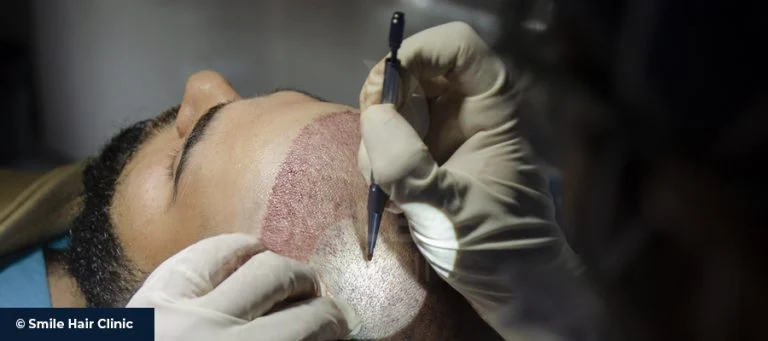
Manual FUE is a hair transplant technique in which each graft is extracted by hand with a fine punch, without a motorized device. The surgeon controls every movement, depth and angle directly, which makes manual FUE the most delicate way to harvest grafts. It is slower than motorized extraction, so sessions are usually smaller, and it is especially useful for fragile or curly follicles, a previously operated donor area or detailed repair work. In Turkey, a manual FUE hair transplant typically costs $2,000 to $4,000, compared with $5,000 to $10,000 in the United Kingdom and $5,000 to $12,000 in the United States.
I am Dr. Mehmet Erdoğan, co-founder of Smile Hair Clinic in Istanbul and an associate member of the International Society of Hair Restoration Surgery (ISHRS). Manual FUE is often described as old-fashioned, but in the right patient it is the best tool we have for protecting a limited or delicate donor area. This page explains how manual FUE works, how it compares with micromotor extraction, who it suits and what it costs.
| Manual FUE at a glance | What to expect |
|---|---|
| Technique | Grafts extracted by hand with a fine punch |
| Implantation | Sapphire FUE channels or DHI |
| Best suited for | Fragile or curly follicles, weak or previously operated donor areas, repairs |
| Typical session size | Up to about 2,000 grafts per session |
| Anesthesia | Local anesthesia, you stay awake |
| Operation time | Up to about 7 hours |
| Stay in Istanbul | Usually 3 days |
| Final result | 12 to 18 months |
| Typical price in Turkey | $2,000 to $4,000 |
What Is Manual FUE?
Manual FUE is a form of follicular unit extraction in which the doctor uses a hand-held punch, rotated by the fingers, to free each follicular unit from the donor area. There is no motor driving the punch, so the speed, depth and direction of every extraction are controlled by the surgeon’s hand.
Manual FUE describes how grafts are extracted, not how they are implanted. Once harvested, the grafts are placed with the same methods used in any modern transplant, usually sapphire FUE channels or DHI implanter pens.
How Is Manual FUE Different From Micromotor FUE?
Most hair transplants today use a micromotor, a small motorized handpiece that rotates or oscillates the punch. It is faster and allows larger sessions. Manual FUE gives up speed in exchange for maximum tactile control.
| Manual FUE | Micromotor FUE | |
|---|---|---|
| How grafts are extracted | Punch turned by hand | Punch driven by a motor |
| Speed | Slower | Faster |
| Typical session size | Up to about 2,000 grafts | Larger sessions possible |
| Tactile control | Maximum, the surgeon feels the tissue directly | Very good in experienced hands |
| Best for | Delicate, curly or scarred donor areas, repairs | Most standard cases, larger areas |
| Cost | Usually higher, because it takes longer | Usually lower |
Both methods produce excellent grafts when they are used by an experienced surgeon. The main risk with either is transection, cutting through a follicle during extraction, and that depends far more on skill and on matching the method to the patient than on the tool itself. For most patients with a healthy donor area, micromotor extraction is the efficient choice, while manual FUE is reserved for the cases where its control makes a real difference.
Who Is a Good Candidate for Manual FUE?
Manual FUE is most useful when the donor area needs to be handled with extra care. Typical candidates include patients whose follicles are curly, curved or fragile under the skin, those with a donor area thinned or scarred by a previous transplant, people needing repair of an earlier operation, and patients who need only a limited number of grafts placed with great precision, for example at the hairline.
Curly and Afro-textured hair often benefits from manual or slow, careful extraction, because the follicle curves beneath the skin. You can read more on the Afro hair transplant page. Manual extraction is also used for delicate facial work such as an eyebrow transplant, where every single graft counts.
When Is Manual FUE Not the Best Choice?
Because it is slower, manual FUE is less practical for large areas. When a patient with advanced hair loss and a healthy donor area needs 3,500 grafts or more, micromotor extraction allows the work to be done in one session without leaving grafts outside the body for longer than necessary. With manual FUE, advanced hair loss is usually treated in two or more sessions.
How Is a Manual FUE Hair Transplant Performed?
A manual FUE operation is done in one day under local anesthesia and lasts up to about seven hours. Design comes first, with the hairline and density planned in front of a mirror. The donor area is then numbed, and each graft is freed by hand with a fine punch, adjusting the angle and depth to the direction of the follicle beneath the skin. Grafts are kept in a cooled preservation solution, and the recipient area is prepared with sapphire blades or the grafts are implanted directly with DHI pens.
What Does Recovery Look Like After Manual FUE?
Recovery is the same as after any FUE transplant, and the donor area often heals quickly because of the controlled, gentle extraction. Most people return to desk work within a few days.
| Time after surgery | What you will notice |
|---|---|
| Days 1 to 3 | Mild swelling, small crusts, first wash at the clinic |
| Days 7 to 10 | Crusts soften and wash off, donor area settles |
| Weeks 2 to 6 | Transplanted hairs shed while the follicles stay in place |
| Months 3 to 4 | New fine hairs start to appear |
| Months 6 to 9 | Clear increase in density |
| Months 12 to 18 | Final density and texture |
This video shows the same stages on a real patient, from the consultation through months three, six and nine to the result at one year.
Day-to-day aftercare instructions are collected in the patient guide.
How Much Does a Manual FUE Hair Transplant Cost?
A manual FUE hair transplant in Turkey typically costs between $2,000 and $4,000, with a 2,000 graft procedure averaging around $2,500. Because manual extraction is slower and depends entirely on the surgeon’s hand, it is usually priced higher than motorized FUE in most countries.
| Country | Typical manual FUE price |
|---|---|
| Turkey | $2,000 to $4,000, usually as an all-inclusive package |
| United Kingdom | $5,000 to $10,000 |
| United States | $5,000 to $12,000, around $10,000 for 2,000 grafts |
The package options and who performs each one are explained on the hair transplant cost in Turkey page, and the whole procedure step by step on the hair transplant in Turkey page.
What Are the Risks of Manual FUE?
Manual FUE is a safe procedure when it is performed by an experienced doctor in a licensed, sterile facility. Temporary swelling, crusts, itching, numbness and shock loss of some native hair are common and settle on their own.
The main risk is technical. Manual extraction requires a high level of skill and concentration over many hours, and fatigue or inexperience can raise the rate of damaged grafts. The technique only delivers its advantages in experienced hands. Before booking, ask who will perform the extraction and how many manual FUE cases they have done. You can read about my background on the about me page.
What Do FUE Results Look Like Over a Year?
Whatever extraction method is used, the final result takes 12 to 18 months to mature. These two patients show how an FUE transplant develops, one with 3,500 grafts followed to 12 months and one with 3,000 grafts followed to nine months.
Frequently Asked Questions About Manual FUE
Is manual FUE better than micromotor FUE?
Not for everyone. Manual FUE is better for delicate or difficult donor areas, while micromotor extraction is more efficient for most standard cases.
How many grafts can be extracted with manual FUE?
Usually up to about 2,000 grafts in one session. Larger restorations are split into two or more sessions.
Does manual FUE leave scars?
It leaves tiny dot-like marks in the donor area that are hidden once the hair grows back. There is no linear scar.
Is manual FUE painful?
Only the local anesthetic injections at the start sting briefly. After that the scalp is numb for the rest of the operation.
Why is manual FUE more expensive?
Because it takes longer and depends entirely on the surgeon’s skill, each graft requires more of the doctor’s time.
Is manual FUE suitable for Afro hair?
Often, yes. Careful manual or slow extraction helps protect curved follicles, and the approach is decided after testing how your follicles behave.
Is manual FUE used for repairing previous transplants?
Yes. A previously operated or scarred donor area is one of the situations where manual extraction is most useful.
Planning Your Manual FUE Hair Transplant With Dr. Mehmet Erdoğan
The right extraction method depends on your donor area, your hair type and the size of your hair loss. If you share a few photos, I will tell you honestly whether manual FUE, micromotor extraction or a combination suits you, and how many sessions your plan would need. You can reach me through the contact page.