


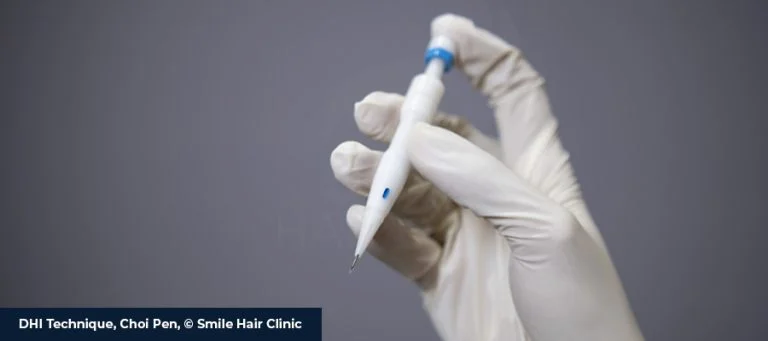
DHI (Direct Hair Implantation) is a hair transplant technique in which each graft is loaded into a pen-shaped Choi implanter and placed directly into the scalp, opening the channel and implanting the graft in one movement. It gives very precise control over the angle, depth and direction of every hair, and it allows grafts to be placed between existing hair, often without shaving the recipient area. In Turkey, a DHI hair transplant typically costs $3,000 to $7,000 as an all-inclusive package.
I am Dr. Mehmet Erdoğan, co-founder of Smile Hair Clinic in Istanbul and an associate member of the International Society of Hair Restoration Surgery (ISHRS). DHI is the technique I reach for when precision matters more than speed, at the front edge of the hairline, at the temples, in women and in patients who want to keep their hair long. Like any technique, it is a tool, not a guarantee. This page explains how DHI works, how it compares with sapphire FUE, who it suits and what to expect.
| DHI hair transplant at a glance | What to expect |
|---|---|
| Technique | FUE extraction, grafts implanted directly with a Choi implanter pen |
| Best suited for | Hairline, temples, women, density between existing hair, unshaven cases |
| Typical graft count | 1,500 to 3,500, larger sessions possible |
| Anesthesia | Local anesthesia, you stay awake |
| Operation time | About 6 to 8 hours |
| Shaving | Recipient area can often stay unshaven |
| Stay in Istanbul | Usually 3 days |
| Final result | 12 to 18 months |
| Typical price in Turkey | $2,000 to $5,000, all-inclusive |
What Is DHI Hair Transplant?
DHI is a variation of follicular unit extraction (FUE). Grafts are taken one by one from the back and sides of the scalp, exactly as in any FUE operation. The difference is in how they are placed. Instead of opening all the channels first and then placing the grafts, each graft is loaded into the hollow needle of a Choi implanter pen and pushed into the scalp in a single step.
Because the doctor controls the pen directly, every graft can be placed at an exact angle and depth, and it can be slipped between existing hairs without disturbing them. That is why DHI is so useful for detailed work and for patients who still have hair in the area being treated.
How Is DHI Different From Sapphire FUE?
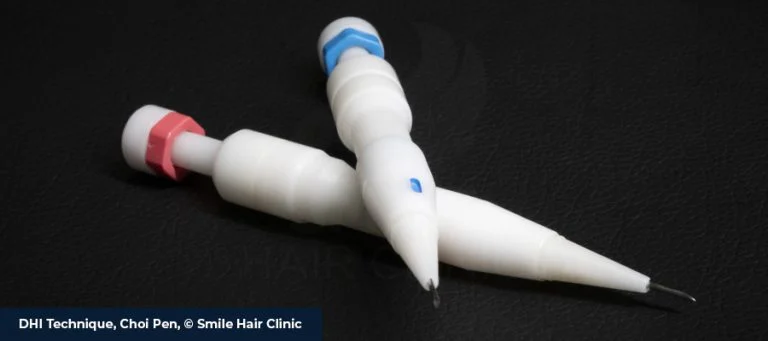
Both techniques use the same extraction. In sapphire FUE, all the channels are opened first with sapphire blades and the grafts are then placed into them. In DHI, opening and implantation happen together with the pen.
| DHI | Sapphire FUE | |
|---|---|---|
| How grafts are placed | Directly with a Choi implanter pen | Into channels opened beforehand with sapphire blades |
| Strongest at | Hairline detail, temples, density between existing hair | Larger areas, crown, dense coverage |
| Shaving | Recipient area can often stay unshaven | Usually full shave |
| Speed for large sessions | Slower | Faster |
| Typical use | Early to moderate hair loss, refinements, women | Moderate to advanced hair loss |
Neither technique is better in every case. Many operations combine them, with sapphire FUE for the main area and DHI for the front edge of the hairline and the temples. You can read more on the sapphire FUE hair transplant page. Laxmy and Omar, a couple from the United States, had their transplants together, one with DHI and one with FUE, and they compare their experiences in this video.
Who Is a Good Candidate for DHI?
DHI suits patients who need precision more than large coverage. Typical candidates are men with a receding hairline or thinning temples, around Norwood Type 2 to Norwood Type 4, patients who want to add density between existing hair, people who need to keep their hair long during recovery for work or privacy, and patients repairing a hairline from a previous transplant.
DHI can also be used for larger areas, but it takes longer per graft, so very large sessions are often done with sapphire FUE or a combination of both. Tightly curled hair needs a specific extraction approach, explained on the Afro hair transplant page.
Is DHI a Good Choice for Women?
Yes, DHI is the technique most often used for women, because female hair loss usually means thinning between existing hair rather than bald areas, and most women want to keep their hair long. Grafts can be placed between existing hairs without shaving the recipient area. More detail is on the female hair transplant page. Chelsea received 2,250 grafts with DHI to restore her hairline, and the other two videos follow women treated with DHI at our clinic.
How Is a DHI Hair Transplant Performed?
A DHI operation is done in one day under local anesthesia and takes about six to eight hours, depending on the number of grafts.
Design comes first. We draw the hairline in front of a mirror and plan where density is needed. A small strip at the back of the head is trimmed for extraction, and the recipient area is often left unshaven. Grafts are extracted one by one and kept in a cooled preservation solution. Each graft is then loaded into a Choi implanter pen, and the pen is used to place it directly into the scalp at the planned angle, depth and direction. Several pens are used in rotation so grafts spend as little time as possible outside the body. The video below explains how DHI and sapphire FUE are applied to a hairline.
Brandon filmed his DHI hair transplant from start to finish, including his consultation and the operation day.
How Many Grafts Can Be Transplanted With DHI?
Most DHI operations use 1,500 to 3,500 grafts, which covers a hairline, the temples or a thinning area between existing hair. Larger sessions are possible with an experienced team, as the 4,900 graft case further down shows, but they take longer, and in many patients a combination with sapphire FUE is more practical. As always, the donor area sets the limit, not the technique.
What Does Recovery Look Like After DHI?
Recovery after DHI is similar to any FUE hair transplant, and it can be more discreet when the recipient area is not shaved, because existing hair hides the small crusts. Most people return to desk work within a few days, and the transplanted hairs shed before regrowing from around month three.
| Time after surgery | What you will notice |
|---|---|
| Days 1 to 3 | Mild swelling, small crusts, first wash at the clinic |
| Days 7 to 10 | Crusts soften and wash off |
| Weeks 2 to 6 | Transplanted hairs shed while the follicles stay in place |
| Months 3 to 4 | New fine hairs start to appear |
| Months 6 to 9 | Clear increase in density |
| Months 12 to 18 | Final density and texture |
Day-to-day aftercare instructions are collected in the patient guide, and supportive treatments such as PRP can help protect the native hair around the grafts.
How Much Does a DHI Hair Transplant Cost in Turkey?
A DHI hair transplant in Turkey typically costs between $2,000 and $5,000 as an all-inclusive package, while the same operation usually costs $10,000 to $20,000 in the United States and £10,000 to £15,000 in the United Kingdom.
| Country | Typical price |
|---|---|
| Turkey | $2,000 to $5,000, all-inclusive |
| United States | $10,000 to $20,000 |
| United Kingdom | £10,000 to £15,000 |
“What really changes the price is who performs the surgery“, followed by the package scope and aftercare. The package options and who performs each one are explained on the hair transplant cost in Turkey page, and the whole procedure step by step on the hair transplant in Turkey page.
What Are the Risks of DHI?
DHI is a safe procedure when it is performed by an experienced doctor in a licensed, sterile facility. Temporary swelling, crusts, itching, numbness and shock loss of some native hair are common and settle on their own.
The main risks come from technique. Grafts placed at the wrong angle or depth can grow unnaturally or fail to grow, and placing grafts between existing hair requires care not to damage the native follicles. The pen does not do the work on its own. Before booking, ask who will place your grafts and how many patients the doctor treats per day. You can read about my background and memberships on the about me page.
What Do DHI Results Look Like?
The results below show what DHI can achieve over a full year. The first follows a 4,900 graft operation for 12 months, the second a 3,300 graft journey, and in the third Darnell talks through every step of his DHI transplant and how it made him feel.
Frequently Asked Questions About DHI Hair Transplant
Is DHI better than FUE?
DHI is a form of FUE. It is more precise for detailed areas and unshaven cases, while sapphire FUE is more efficient for large areas. The best choice depends on your hair loss.
Can DHI be done without shaving?
Often, yes. The recipient area can usually stay unshaven, and only a small strip at the back of the head is trimmed for extraction.
Is DHI painful?
Only the local anesthetic injections at the start sting briefly. After that the scalp is numb for the rest of the operation.
Does DHI leave scars?
DHI leaves tiny dot-like marks in the donor area that are hidden once the hair grows back. There is no linear scar.
When can I go back to work after DHI?
Most people return to desk work within a few days. With the unshaven approach, the treated area is easier to hide.
Can DHI and sapphire FUE be combined?
Yes. A combination is common, with sapphire FUE for the main area and DHI for the hairline edge and temples.
Does DHI guarantee a better result?
No technique does. The result depends on the design, the surgeon’s skill, the donor area and aftercare, not on the name of the method.
Planning Your DHI Hair Transplant With Dr. Mehmet Erdoğan
The right technique is the one that fits your hair loss, your hair and your daily life. If you share a few photos, I will tell you honestly whether DHI, sapphire FUE or a combination suits you, and how many grafts your plan would need. You can reach me through the contact page.