


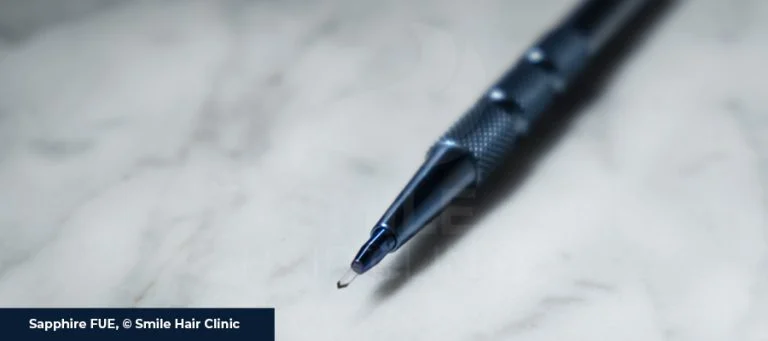
Sapphire FUE is a hair transplant technique in which grafts are extracted one by one with FUE, and the tiny channels that receive them are opened with blades made of sapphire instead of steel. Sapphire blades are very sharp, smooth and stay sharp throughout the operation, which allows fine, precisely angled channels and dense packing over larger areas. It is done under local anesthesia in one day, and in Turkey a sapphire FUE hair transplant typically costs $2,000 to $5,000 as an all-inclusive package.
I am Dr. Mehmet Erdoğan, co-founder of Smile Hair Clinic in Istanbul and an associate member of the International Society of Hair Restoration Surgery (ISHRS). Sapphire FUE is the technique I use most often for male pattern hair loss. It is a refinement of FUE, not a different operation, and the blade alone does not decide the result. Design, angle, depth and density planning do. This page explains how sapphire FUE works, how it compares with steel FUE and DHI, who it suits and what to expect.
| Sapphire FUE at a glance | What to expect |
|---|---|
| Technique | FUE extraction, recipient channels opened with sapphire blades |
| Best suited for | Moderate to advanced hair loss, larger areas, dense packing |
| Typical graft count | 2,500 to 4,500, depending on the area |
| Anesthesia | Local anesthesia, you stay awake |
| Operation time | About 6 to 8 hours |
| Shaving | Usually a full shave |
| Stay in Istanbul | Usually 3 days |
| Final result | 12 to 18 months |
| Typical price in Turkey | $2,000 to $5,000, all-inclusive |
What Is Sapphire FUE?
Sapphire FUE is a variation of follicular unit extraction (FUE), the standard method of modern hair transplantation. Grafts are taken one by one from the back and sides of the scalp, exactly as in classic FUE. The difference is in the next step. The channels in the recipient area are opened with a blade made of synthetic sapphire, a crystal that is extremely hard and can be polished to a very fine, smooth edge.
The channels are the most important part of any hair transplant, because their angle, direction, depth and spacing decide how natural the new hair looks. Sapphire blades make it easier to open small, clean channels at precise angles, which is why the technique has become so widely used in Turkey.
How Is Sapphire FUE Different From Classic FUE With Steel Blades?
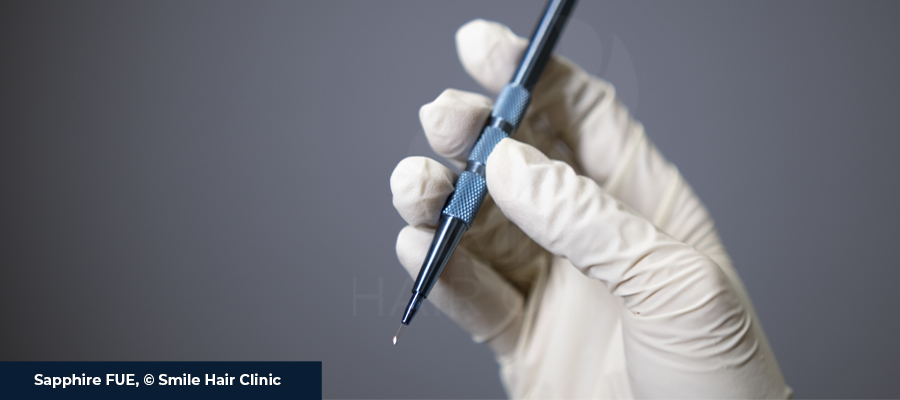
The extraction is the same. Only the tool used to open the recipient channels changes.
| Sapphire FUE | Classic FUE with steel blades | |
|---|---|---|
| Blade material | Synthetic sapphire | Steel |
| Sharpness during the session | Stays sharp | Can dull over a long session |
| Channel shape | Small, smooth V-shaped channels | Depends on the blade, often slightly wider |
| Dense packing | Easier to place grafts close together | Possible, but depends more on technique |
| Early healing | Often calmer, with less crusting | Generally good with correct technique |
It is worth being honest about the evidence. Some studies have reported better graft survival and faster healing with sapphire blades, while others found that carefully made steel blades perform just as well. In practice, the surgeon’s hand matters more than the blade. Sapphire simply gives an experienced surgeon a very reliable tool.
How Is Sapphire FUE Different From DHI?
Both techniques use the same FUE extraction. The difference is how grafts are placed. In sapphire FUE, all channels are opened first and the grafts are then placed into them. In DHI, each graft is loaded into a pen and implanted directly, opening the channel and placing the graft in one move.
| Sapphire FUE | DHI | |
|---|---|---|
| How grafts are placed | Channels opened with sapphire blades, then grafts placed | Grafts implanted directly with a Choi implanter pen |
| Best for | Larger areas, crown, dense coverage | Hairline detail, temples, filling between existing hair |
| Shaving | Usually full shave | Recipient area can often stay unshaven |
| Typical use | Moderate to advanced hair loss | Smaller areas and refinements |
The two are often combined in one operation, with sapphire FUE for the main area and DHI for the front edge of the hairline and the temples. The technique follows your scalp and your goals, not a package name. More detail is on the DHI hair transplant page.
Who Is a Good Candidate for Sapphire FUE?
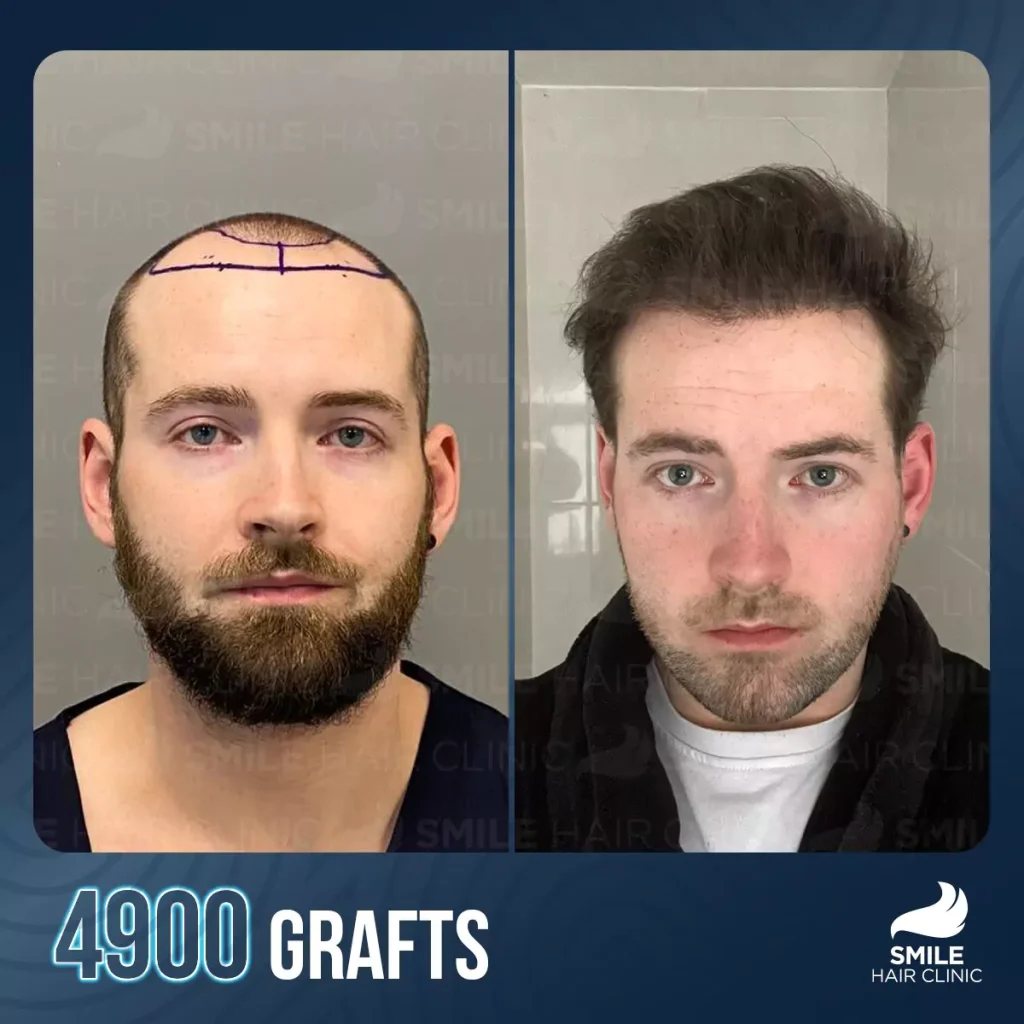
Sapphire FUE suits most men with pattern hair loss who need coverage of a larger area, typically from Norwood Type 3 to Norwood Type 6, and who have a donor area dense enough to supply the grafts. It is especially useful for the crown, where hair grows in a whorl and channel direction has to change constantly, and for repairing previous transplants where grafts were placed at unnatural angles.
For very small areas, minimal thinning or patients who want to keep their hair long during recovery, DHI or an unshaven technique may be a better fit. Women with thinning between existing hair are usually treated with DHI, and you can read more on the female hair transplant page. Tightly curled hair needs its own approach, explained on the Afro hair transplant page.
How Is a Sapphire FUE Hair Transplant Performed?
A sapphire FUE operation is done in one day under local anesthesia and takes about six to eight hours, depending on the number of grafts.
Design comes first. We draw the hairline on your scalp in front of a mirror and plan the density for each area. The scalp is then shaved and numbed. Grafts are extracted from the donor area one by one and kept in a cooled preservation solution. Next, the recipient channels are opened with sapphire blades, and this is the step that decides angle, direction and density, so in my operations it is never delegated. Finally, the grafts are placed into the channels one by one.
Dr. Gökay Bilgin, my co-founder, walks through the four stages of the procedure, from preparation and extraction to channel opening and implantation.
Luciano filmed his whole sapphire FUE journey, from the consultation and planning to the operation, the first wash and his thoughts afterwards.
How Many Grafts Does Sapphire FUE Need?
Most sapphire FUE operations use 2,500 to 4,500 grafts. A receding hairline at Norwood Type 3 sits at the lower end, while a hairline and crown together at Norwood Type 5 or 6 sits higher. The final number is always set by what your donor area can safely give over a lifetime, not by a target number. Overharvesting leaves a thin donor area that cannot be repaired.
This patient needed 3,900 grafts to restore his hairline and crown, and the video follows his progress at three, six and nine months.
What Does Recovery Look Like After Sapphire FUE?
Recovery follows the usual pattern of an FUE hair transplant. Small crusts and mild swelling settle within the first one to two weeks, most people return to desk work within a few days, and the transplanted hairs shed before regrowing from around month three.
| Time after surgery | What you will notice |
|---|---|
| Days 1 to 3 | Mild swelling on the forehead, small crusts, first wash at the clinic |
| Days 7 to 10 | Crusts soften and wash off, redness fades |
| Weeks 2 to 8 | Transplanted hairs shed while the follicles stay in place |
| Months 3 to 4 | New hairs start to appear |
| Months 6 to 9 | Clear increase in density |
| Months 12 to 18 | Final density and texture |
The stages in the table are easier to understand on a real scalp. This video follows a 3,500 graft patient from the day of the operation through shedding and regrowth to the result at 12 months.
Day-to-day aftercare instructions on washing, sleeping and returning to sport are collected in the patient guide.
Is Sapphire FUE Permanent?
Yes. The transplanted hair comes from an area of the scalp that is resistant to pattern hair loss, and it keeps that quality after it is moved. The surrounding native hair can still thin over time, which is why medical treatment and supportive options such as PRP are often part of the long-term plan.
How Much Does a Sapphire FUE Hair Transplant Cost in Turkey?
A sapphire FUE hair transplant in Turkey typically costs between $2,000 and $5,000 as an all-inclusive package, while the same operation usually costs $10,000 to $20,000 in the United States and £10,000 to £15,000 in the United Kingdom.
| Country | Typical price |
|---|---|
| Turkey | $2,000 to $5,000, all-inclusive |
| United States | $10,000 to $20,000 |
| United Kingdom | £10,000 to £15,000 |
Most Turkish clinics price sapphire FUE as a package rather than per graft. What really changes the price is who performs the surgery, followed by the package scope and aftercare. The package options and who performs each one are explained on the hair transplant in Turkey cost page.
What Are the Risks of Sapphire FUE?
Sapphire FUE is a safe procedure when it is performed by an experienced doctor in a licensed, sterile facility. Temporary swelling, crusts, itching, numbness and shock loss of some native hair are common and settle on their own.
The risks that matter are the same as in any hair transplant. Channels opened too deep, too close together or at the wrong angle can reduce graft survival or produce an unnatural look, and overharvesting can thin the donor area permanently. A sapphire blade does not prevent these problems, only a careful surgeon does. Before booking, ask who will open your channels and how many patients the doctor treats per day. You can read about my background and memberships on the about me page.
What Do Sapphire FUE Results Look Like?
The best way to judge what sapphire FUE can do is to watch real results develop over a full year. The 4,500 graft result below shows the hairline design, the three-month stage and the final result at 12 months, and the other two follow patients with 3,500 and 4,200 grafts. Results always depend on the starting point, the donor area and how the patient cares for the grafts.
Frequently Asked Questions About Sapphire FUE
Is sapphire FUE better than regular FUE?
Sapphire blades make it easier to open small, precise channels, but the result depends far more on the surgeon than on the blade.
Is sapphire FUE painful?
Only the local anesthetic injections at the start sting briefly. After that the scalp is numb for the rest of the operation.
Does sapphire FUE leave scars?
FUE leaves tiny dot-like marks in the donor area that are hidden once the hair grows back. There is no linear scar.
Do I have to shave my head for sapphire FUE?
Usually yes. If you need to keep your hair long, DHI or an unshaven technique may be more suitable.
Can sapphire FUE and DHI be combined?
Yes. A combination is common, with sapphire FUE for the main area and DHI for the hairline edge and temples.
When can I go back to work?
Most people return to desk work within a few days. Crusts remain visible for about ten days.
Is sapphire FUE suitable for women?
It can be, for larger areas. Many women with thinning between existing hair are better suited to DHI without shaving.
Are all sapphire FUE clinics the same?
No. The name of the technique says nothing about who performs it. Ask who designs your hairline and who opens the channels.
Planning Your Sapphire FUE Hair Transplant With Dr. Mehmet Erdoğan
The right technique is the one that fits your hair loss, your donor area and your goals. If you share a few photos, I will tell you honestly whether sapphire FUE, DHI or a combination suits you, and how many grafts your plan would need. You can reach me through the contact page.