


A hair transplant in Turkey is a minimally invasive surgery, performed under local anesthesia, in which healthy follicles from the back and sides of your scalp are moved to areas thinned by hair loss. Most international patients spend three days in Istanbul, fly home after their first wash and see the final result 12 to 18 months later. Typical prices in the Turkish market range from $2,000 to $5,500 for an all-inclusive package, a fraction of what the same surgery costs in the United States or the United Kingdom.
I am Dr. Mehmet Erdoğan, co-founder of Smile Hair Clinic in Istanbul and an associate member of the International Society of Hair Restoration Surgery (ISHRS). Before focusing on hair restoration, I directed an international patient center for five years, so I have seen the Turkish health tourism system from both the surgical and the patient journey side. This page answers the questions my patients ask most often before they book, from technique and graft numbers to recovery, cost and how to choose a surgeon.
| Hair transplant in Turkey at a glance | What to expect |
|---|---|
| Main techniques | Sapphire FUE, DHI, manual or micromotor FUE, unshaven FUE |
| Anesthesia | Local anesthesia, you stay awake and comfortable |
| Operation time | About 6 to 8 hours, depending on graft count |
| Stay in Istanbul | Usually 3 days |
| Return to desk work | Within a few days of the operation |
| Visible new growth | From month 3 to 4 |
| Final result | 12 to 18 months |
| Typical market price | $2,000 to $5,000, all-inclusive |
What Is a Hair Transplant?
A hair transplant is the surgical relocation of your own hair follicles from a donor area that is genetically resistant to balding into a thinning or bald recipient area. Because the follicles are your own tissue, there is no rejection, and the transplanted hair keeps the resistance it had at the back of the head, which is why the result is permanent.
Follicles grow in natural groups of one to four hairs called follicular units, and each unit becomes one graft. In a comparison of extraction methods, the average graft carried just over two hairs, so a 3,000 graft session moves roughly 6,000 hairs. The number of grafts matters, but the way they are placed, angled and distributed is what decides whether a hairline looks natural.
Why Do So Many People Choose Turkey for a Hair Transplant?
People choose Turkey because surgeons there perform hair transplants every working day, the price is usually 60 to 80 percent lower than in Western Europe or North America, and the all-inclusive package model removes most of the planning stress of surgery abroad. Industry estimates put the number of people who travel to Turkey for hair restoration at around one million a year, which has made Istanbul the reference city for the procedure.
That concentration of experience has a practical effect. Techniques such as sapphire blades, the Choi implanter for DHI and unshaven FUE became routine in Turkish clinics early, and teams refine them on a daily basis rather than a few times a month. Lower operating costs, from rent to staff salaries, explain the price difference far more than any compromise in quality.
ABC News followed an American patient through his surgery at Smile Hair Clinic and interviewed him again a year later, which gives a clear outside view of why so many people make the trip.
Is a Hair Transplant in Turkey Safe?
A hair transplant in Turkey is safe when it is carried out by a licensed physician in a facility authorized by the Turkish Ministry of Health. Clinics that treat international patients must hold an international health tourism authorization, and the facility is inspected by the Ministry. Smile Hair Clinic goes a step further as the only hair transplant clinic in the world holding an A-Rating from TEMOS International Healthcare Accreditation, renewed in 2026 after a full audit of infection control, patient safety and international patient management.
The real risk in Turkey sits with high-volume operations where technicians perform the surgery and the doctor appears only for a signature. Asking who will extract, who will open the channels and how many patients the team treats that day tells you more about safety than the price does.
Which Hair Transplant Techniques Are Used in Turkey?
Almost every modern hair transplant in Turkey uses follicular unit extraction (FUE), where grafts are removed one by one with a fine punch, and then differs in how the recipient area is prepared and how the grafts are placed. The older strip method (FUT), which removes a band of scalp and leaves a linear scar, has practically disappeared from Turkish clinics, and we do not perform it.
| Technique | How it works | Best suited for | Shaving |
|---|---|---|---|
| Sapphire FUE | Recipient channels are opened with smooth sapphire blades before implantation | Larger areas and dense packing, most male pattern cases | Usually full shave |
| DHI | Grafts are loaded into a Choi implanter pen and placed directly, opening and implanting in one move | Hairline refinement, density between existing hair | Possible without shaving the recipient area |
| Manual FUE | Grafts are extracted with a hand-held punch instead of a motorized one | Delicate or curly hair, previously operated donor areas | Donor area shaved |
| Unshaven or Long FUE | Only a hidden donor strip is trimmed and grafts keep their length | Patients who need to return to work or social life quickly | Minimal, hidden by surrounding hair |
The blade used to open channels does make a measurable difference. In a prospective study of 1,000 patients, sapphire blades were linked to a graft survival rate of 94.7 percent against 88.9 percent with steel blades. My own preference for most male pattern cases is sapphire FUE with micromotor extraction, while DHI and unshaven techniques are chosen when the goal is density between existing hair or a discreet recovery. The technique follows the scalp, not the package.
When scalp hair is limited, beard or chest hair can be added through body hair transplantation. The same surgical principles also apply to the face, which is why many patients combine their visit with a beard transplant, an eyebrow transplant, a moustache transplant or sideburn transplantation.
Who Is a Good Candidate for a Hair Transplant?
A good candidate has androgenetic alopecia that has reached a reasonably stable pattern, a donor area dense enough to supply the grafts needed, and general health that allows minor surgery under local anesthesia. Hair loss of this kind is extremely common. In a population study of men aged 46, 68.5 percent of participants had androgenetic alopecia.
Age matters mainly because hair loss keeps progressing. In men in their early twenties the final pattern is often still unclear, so I plan conservatively and protect donor hair for the future. A recent review of candidacy recommends stabilizing hair loss with medical therapy before surgery where possible and screening for conditions that make transplantation unsuitable, such as active scarring alopecias. Uncontrolled diabetes, bleeding disorders and certain infections need clearance first.
Women can also be excellent candidates when thinning is localized and the donor area is stable, which is covered in detail on the female hair transplant page. Tightly curled hair needs a specific extraction approach, explained under Afro hair transplant. For early thinning where surgery is not yet needed, hair mesotherapy or PRP treatment can strengthen existing hair.
How Many Grafts Will You Need?
The graft count depends on the size of the area, the density you want and, above all, what your donor area can safely give over a lifetime. A receding hairline at Norwood Type 2 or Norwood Type 3 needs far fewer grafts than a crown and frontal combination at Norwood Type 5 or beyond. Knowing your Norwood stage gives a useful starting point, but the final number is set only after the donor area has been examined.
I will not plan a number simply because it sounds generous. Overharvesting leaves a see-through donor area that cannot be repaired, so the plan always reserves grafts for hair you may lose in the future.
This consultation with a 4,600 graft patient shows how the donor area, the hairline and the graft plan are worked out together before the operation day.
What Happens During a Hair Transplant in Turkey, Day by Day?
The whole process usually takes three days in Istanbul, with consultation and tests on the first day, surgery on the second and the first wash and check-up on the third. Airport transfers, the hotel and an interpreter are arranged before you land, so the only thing you need to plan is your flight.
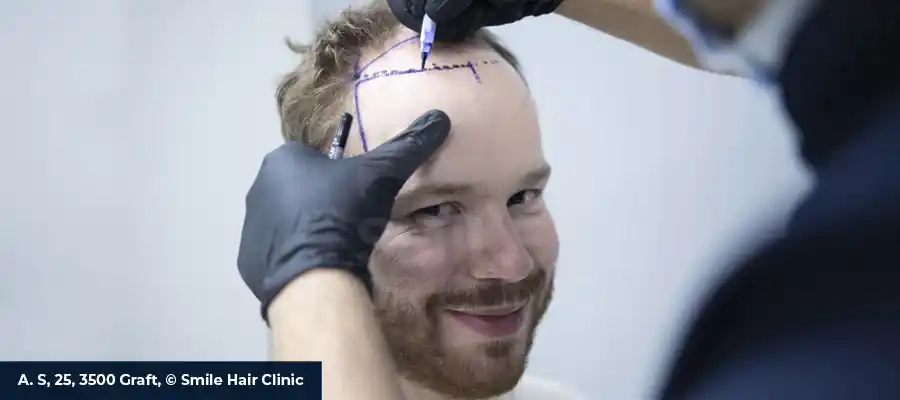
On arrival day you meet your doctor in person. We examine the donor area under magnification, listen to your expectations and draw the hairline on your scalp so you can see it in the mirror before anything is decided. Blood tests confirm that surgery is safe for you that week.
On the day of surgery, local anesthesia numbs the donor and recipient areas. Grafts are extracted one by one and kept in a cooled preservation solution while the recipient channels are opened. Opening the channels is the step that decides angle, direction and density, so in my operations this step is never delegated. The grafts are then implanted and the session usually ends within six to eight hours, with breaks for meals. A recent expert consensus on FUE outcomes identified graft handling, preservation and implantation as the stages where survival is most easily won or lost.
The day after surgery, the dressing is removed and the first wash is done at the clinic. You go home with written aftercare instructions, medications and a care kit, and most patients fly the same day or the next.
The BBC documentary on Paul Readman follows every one of these steps, from his consultation and planning with Dr. Gökay Bilgin and me to extraction, implantation, the shock loss period and his result nine months later.
How Much Does a Hair Transplant Cost in Turkey?
A hair transplant in Turkey typically costs between $2,000 and $5,000, while accredited, doctor-led clinics generally charge from about $2,500 up to $7,000. The same procedure costs roughly $10,000 to $20,000 in the United States and £10,000 to £15,000 in the United Kingdom, which is why the saving remains large even after flights.
| Country | Typical hair transplant price | Pricing model |
|---|---|---|
| Turkey | $2,000 to $5,000 | All-inclusive package |
| Turkey, accredited doctor-led clinics | $2,500 to $7,000 | All-inclusive package |
| United States | $10,000 to $20,000 | Usually per graft, surgery only |
| United Kingdom | £10,000 to £15,000 | Usually per graft, surgery only |
The package options and who performs each one are explained on the hair transplant cost in Turkey page.
What Is Included in an All-Inclusive Package?
An all-inclusive package covers the operation and everything around it, so the quoted price is the price you pay. At Smile Hair Clinic this means the in-person consultation and blood tests, the surgery, medications and anesthesia, hotel accommodation, VIP transfers between the airport, hotel and clinic, an interpreter, the first wash, an aftercare kit and online follow-up until your result is final.
Smile Hair Clinic Packages and Who Performs Them
Smile Hair Clinic works with three packages, and the main difference between them is the surgeon. Operations I perform personally are part of the Diamond package.
| Package | Price | Performed by |
|---|---|---|
| Gold | about $2,680 (€2,390) | Dr. Ali Osman Soluk or Dr. M. Reşat Arpacı |
| Platinum | about $3,690 (€3,290) | Dr. Ali Osman Soluk or Dr. M. Reşat Arpacı |
| Diamond | about $6,490 (€5,790) | Dr. Mehmet Erdoğan, Dr. Gökay Bilgin or head doctor Dr. Firdavs Ahmedov |
Unshaven and Long FUE are available in every package when they suit your hair, because that decision belongs to the doctor’s assessment rather than the price tier. Dollar amounts are approximate and follow the current euro exchange rate.
What Does Recovery Look Like After a Hair Transplant?
Recovery is quick on the surface and slow underneath. Swelling and redness settle within the first week or two, scabs clear by around day 10, and most transplanted hairs then shed before regrowing from month three onward. The table shows the timeline I discuss with every patient.
| Time after surgery | What you will notice |
|---|---|
| Days 1 to 3 | Mild swelling on the forehead, tiny crusts around each graft, first wash at the clinic |
| Days 7 to 10 | Crusts soften and wash off, redness fades, most people look presentable |
| Weeks 2 to 8 | Shock loss, where transplanted hairs shed while the follicles stay in place |
| Months 3 to 4 | New hairs start to appear, often fine at first |
| Month 6 | Clear visible change, hair thickens and lengthens |
| Months 12 to 18 | Final density and texture, crown areas often take the longest |
Seeing the stages on a real scalp is more useful than any description. These two patients documented their progress month by month.
Survival rates in well-run surgery are high. In one series of hairline restorations, 93.1 percent of transplanted grafts had survived at nine months. Aftercare protects that number. In a multicenter cohort of 1,090 patients, folliculitis and a delayed first wash were linked to persistent redness around grafts, which in turn was associated with lower graft survival. Smoking deserves particular attention, as it was the most frequent risk factor in a case series of recipient site necrosis, a rare but serious complication.
A transplant does not stop your native hair from thinning. In a randomized trial, 94 percent of men taking finasteride around their transplant showed a visible improvement in the frontal scalp, against 67 percent on placebo. Whether medication is right for you is a conversation for your consultation, alongside supportive options such as exosome hair therapy. Day-to-day instructions on sleeping, washing and returning to sport are collected in the patient guide.
Is a Hair Transplant Worth It?
For most patients with stable androgenetic alopecia and a healthy donor area, yes, and the benefit goes beyond appearance. In a prospective study of men treated with FUE, quality of life and life satisfaction scores rose after the procedure while stress and anxiety scores fell. Before-and-after cases with similar starting points are the best way to judge what is realistic for you, and you can ask to see results that match your hair loss during your online assessment.
How Should You Choose a Hair Transplant Surgeon in Turkey?
Choose the surgeon before you choose the price. Ask who designs the hairline, who opens the recipient channels and how many patients the doctor operates on per day, then confirm the answers in writing. At Smile Hair Clinic each doctor takes at most two patients a day, which is what makes it possible for the doctor to stay involved in the critical steps of every operation.
Beyond that, look for verifiable credentials, such as membership of the ISHRS and FUE Europe, independent accreditation, a long record of cases similar to yours and a clear aftercare plan once you are home. Be wary of graft counts that sound too good to be true and of prices far below the market range, because both usually mean that steps are being cut somewhere. Clinics that have been examined by journalists and broadcasters are easier to trust, and you can see that coverage on the press and media page.
ABC Australia and Norway’s NRK both filmed inside our operating rooms, and both reports focus on the questions every patient should ask before choosing a clinic.
What Do Real Patients Say About Their Hair Transplant in Turkey?
Patients who have been through the process describe it far better than any brochure. The stories below come from people of different ages, countries and stages of hair loss, filmed during their stay in Istanbul and in the months after.
Paul, a Short Look at His Result
A one-minute summary of the BBC patient’s transformation, for anyone who wants the result without the full documentary.
Clive Vanderwagen, TEDx Speaker
Clive describes how he felt the moment he first saw his new hairline after the operation.
Lewis and His Before and After
Lewis shares his result and how his everyday life changed once the new hair had grown in.
4,100 Grafts, a British Patient’s 12-Month Result
A full year of progress after a 4,100 graft operation, filmed at each stage.
3,550 Grafts, From Consultation to 12 Months
The complete journey from the first assessment in Istanbul to the final result.
Marcus After 4,000 Grafts
Marcus looks back on his decision, the operation and the months of growth that followed.
Marwan’s Hair Transplant Journey
A behind-the-scenes look at Marwan’s stay and operation in Istanbul.
Two Brothers, One Trip
Two brothers explain whether going through the operation together made it easier.
Marcell Fülöp, Bodybuilding Champion
An athlete’s view on the procedure, the recovery and getting back to training.
Riley Lemon’s Documentary in Istanbul
A content creator films his own hair transplant journey from arrival to result.
Frequently Asked Questions About Hair Transplant in Turkey
How long do I need to stay in Turkey for a hair transplant?
Three days is enough for most patients. You arrive and have your consultation and tests on the first day, have the operation on the second and the first wash and check-up on the third, after which you can fly home.
Does a hair transplant hurt?
The only uncomfortable moment is the local anesthetic injection at the start, which feels like a few seconds of stinging. After that the scalp is numb for the rest of the operation, and post-operative discomfort is usually mild and managed with standard painkillers.
When can I fly home after a hair transplant?
Most patients fly the day after their first wash, usually two or three days after surgery. Wear a loose, clean cap if you wish, avoid knocking your head when loading luggage and keep the scalp dry during the journey.
When can I go back to work?
Desk work is possible within a few days, though crusts remain visible for about ten days. Jobs involving heavy lifting, dust or a helmet usually need two to four weeks, and your doctor will give you a date based on your case.
Is a hair transplant permanent?
Transplanted hair is taken from a zone resistant to the hormone that drives male pattern hair loss, so it continues to grow for life. The surrounding native hair can still thin with age, which is why long-term planning and, for some patients, medical treatment matter.
How many grafts can be transplanted in one session?
The safe limit depends on donor density and scalp size rather than a fixed number. Many sessions fall between 2,500 and 4,000 grafts, and patients with advanced hair loss may need a second session once the first result has matured.
Does the price change with the number of grafts?
Not at most Turkish clinics, including Smile Hair Clinic, where the package price covers the number of grafts your donor area can safely provide. Per graft pricing is more common in the UK and the US.
Does health insurance cover a hair transplant?
Insurance generally treats hair transplantation for pattern hair loss as cosmetic and does not cover it. Reconstructive cases after burns, trauma or surgery are sometimes assessed differently, so check with your insurer.
Can women have a hair transplant in Turkey?
Yes, provided the cause of thinning has been identified and the donor area is stable. DHI and unshaven techniques are often preferred so that existing hair can stay long during recovery.
When can I exercise, swim or go in the sun again?
Light walking is fine straight away. Most patients return to the gym after about two weeks and to contact sports or swimming after a month, and the scalp should be protected from strong sun with a hat for the first few months.
How do I book a hair transplant with Dr. Mehmet Erdoğan?
Send clear photos of your scalp through the contact form or WhatsApp for a free online assessment. A €250 deposit paid through a secure card link locks your package price and is deducted from the total. Your surgery date is reserved once you send your flight tickets, and the balance is paid at the clinic on arrival, preferably in cash because card payments for the balance carry a 10 percent surcharge. Cards must be in the patient’s own name.
Planning Your Hair Transplant With Dr. Mehmet Erdoğan
The best results come from a plan that fits your hair loss today and still makes sense in ten years. If you share photos of your scalp, I will review them, tell you honestly whether surgery is the right step now and explain which technique and graft range suits your donor area. You can reach me through the contact page, and more about my training and memberships is on the about me page.