


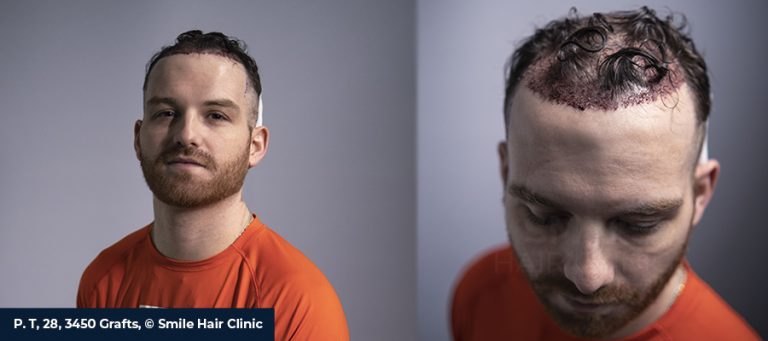
An unshaven hair transplant is an FUE procedure performed without shaving your whole head, so you can keep your hairstyle and return to daily life more discreetly. Depending on the case, the recipient area stays unshaven, only a small hidden strip at the back is trimmed, or the grafts are extracted with their hair left long, which is known as Long FUE. It suits smaller areas such as the hairline, temples or thinning between existing hair, and in Turkey it typically costs $2,400 to $5,000 as an all-inclusive package.
I am Dr. Mehmet Erdoğan, co-founder of Smile Hair Clinic in Istanbul and an associate member of the International Society of Hair Restoration Surgery (ISHRS). Many patients ask for an unshaven transplant because they cannot take long off work or simply do not want anyone to know. It is a very good option for the right case, but it has limits, and whether it is suitable is a medical decision, not a package choice. This page explains the types of unshaven transplant, who they suit and what to expect.
| Unshaven hair transplant at a glance | What to expect |
|---|---|
| Technique | FUE extraction, usually DHI implantation between existing hair |
| Best suited for | Hairline, temples, thinning between existing hair, women |
| Typical session size | Smaller than a shaved session, set by the area and donor |
| Anesthesia | Local anesthesia, you stay awake |
| Operation time | Longer per graft than a shaved FUE |
| Visibility after surgery | Crusts largely hidden by your own hair |
| Stay in Istanbul | Usually 3 days |
| Final result | 12 to 18 months |
| Typical price in Turkey | $2,400 to $5,000, all-inclusive |
What Is an Unshaven Hair Transplant?
An unshaven hair transplant uses the same FUE method as any modern hair transplant, but the head is not fully shaved. Grafts are extracted from the back of the scalp and implanted into the thinning area while most of your existing hair stays at its normal length. Implantation is usually done with DHI, because the Choi implanter pen can place grafts precisely between existing hairs without disturbing them.
The main benefit is discretion. Your own hair covers the small crusts in the first days, so the operation is much harder to notice when you go back to work or meet people.
What Are the Types of Unshaven Hair Transplant?
“Unshaven” can mean several different things, and the right one depends on how much hair you need and where.
| Type | Donor area | Recipient area | Best for |
|---|---|---|---|
| Unshaven recipient | Shaved | Not shaved | Patients who keep long hair on top and can hide a short back and sides |
| Partial shave | Only a narrow strip trimmed, hidden under the hair above it | Not shaved | Hairline and temple work in patients who want maximum discretion |
| Fully unshaven | Not shaved, grafts taken between existing hairs | Not shaved | Small refinements and low graft numbers |
| Long FUE | Grafts extracted with their hair left long | Not shaved | Patients who want to see the new hairline immediately |
What Is Long FUE?
Long FUE is a form of unshaven transplant in which the grafts are extracted and implanted with their hair still long, instead of being trimmed short first. This lets you and your doctor see the shape of the new hairline right after the operation, which helps with design and makes the result easier to blend in from day one. It is the most demanding version technically, takes longer and is usually used for smaller areas such as the hairline and temples. The transplanted hairs still shed in the following weeks and regrow from around month three, like in any transplant.
Who Is a Good Candidate for an Unshaven Hair Transplant?
An unshaven transplant suits patients who need a limited number of grafts in a defined area and who still have hair around it. Typical candidates are men with a receding hairline or thinning temples, around Norwood Type 2 to Norwood Type 3, women with thinning between existing hair, people repairing or refining a previous transplant, and anyone whose work or private life makes a shaved head impractical.
Women are often the best candidates, because most female hair loss is thinning between existing hair and most women want to keep their hair long. You can read more on the female hair transplant page.
Can an Unshaven Transplant Work for Advanced Hair Loss?
In most cases, extensive hair loss is better treated with a shaved operation. When a large area such as the hairline and crown together needs to be covered, typically from Norwood Type 4 onwards, the number of grafts is high and extracting and placing them between long hairs takes much longer. Sapphire FUE with a full shave usually gives a more efficient and predictable result.
There are exceptions. In selected patients with a strong donor area, advanced hair loss can be restored unshaven in two planned sessions. Ido had Norwood Type 6 hair loss and received 7,750 grafts across two operations, also using beard hair as an extra donor source. In this video he describes the whole experience, including his consultation with Dr. Firdavs Ahmedov.
How Is an Unshaven Hair Transplant Performed?
An unshaven transplant is done in one day under local anesthesia. Design comes first, with the hairline or density map drawn in front of a mirror. Depending on the type, a narrow strip at the back of the head may be trimmed, or grafts may be taken between long hairs. Grafts are then implanted, usually with DHI, between the existing hairs at the planned angle and depth.
Because the doctor has to work around long hair, every step takes longer than in a shaved operation. This is the main reason unshaven sessions are kept smaller.
Casper, a Danish content creator, chose an unshaven transplant with Dr. Gökay Bilgin so he could keep filming without a shaved head. His video follows the whole process.
This patient received 2,700 grafts without shaving and shares his journey from the decision to the result.
What Does Recovery Look Like After an Unshaven Transplant?
The healing process is the same as after any FUE transplant, but it is far less visible. Your own hair hides most of the small crusts in the first week, and many patients go back to work within a few days without anyone noticing.
| Time after surgery | What you will notice |
|---|---|
| Days 1 to 3 | Mild swelling, small crusts hidden under existing hair, first wash at the clinic |
| Days 7 to 10 | Crusts soften and wash off |
| Weeks 2 to 6 | Transplanted hairs shed while the follicles stay in place |
| Months 3 to 4 | New fine hairs start to appear |
| Months 6 to 9 | Clear increase in density |
| Months 12 to 18 | Final density and texture |
Washing needs a little extra care, because long hair must be rinsed gently without pulling on the grafts. Your aftercare instructions explain how, and more advice is collected in the patient guide.
How Much Does an Unshaven Hair Transplant Cost?
An unshaven or Long FUE hair transplant in Turkey typically costs between $2,400 and $5,000 as an all-inclusive package, depending on the number of grafts and the type of unshaven technique. Because the work is slower and more demanding, it is usually priced higher than a shaved operation in most countries, and the gap with Turkey becomes even wider.
| Country | Unshaven or Long FUE | Compared with shaved FUE |
|---|---|---|
| Turkey | $2,400 to $5,000, all-inclusive package | Often within the same package range |
| United Kingdom | About £6,000 to £8,000 with a minimal shave, and £10,000 to £15,000 fully unshaven | Roughly 30 to 50 percent more |
| United States | About $8 to $15 per graft, so a 2,000 graft session often reaches $16,000 to $30,000 | About $3 to $5 more per graft |
In the United Kingdom and the United States, unshaven transplants are usually charged per graft and for the surgery only, while Turkish packages also cover the hotel, transfers, medication and aftercare. At Smile Hair Clinic, unshaven and Long FUE techniques are available in every package when they suit your hair, because the decision belongs to the doctor’s assessment rather than the price tier. What really changes the price is who performs the surgery, and the package options are explained on the hair transplant in Turkey page.
Package prices and everything else that affects the final cost are explained on the hair transplant cost in Turkey page.
What Are the Risks of an Unshaven Hair Transplant?
An unshaven transplant is safe when it is performed by an experienced doctor. The usual effects are the same as in any FUE transplant, with temporary swelling, small crusts, itching, numbness and shock loss of some native hair.
The specific risks come from working around long hair. Native hairs can be damaged if grafts are placed carelessly between them, and keeping the area clean needs extra attention in the first days. The technique is also very dependent on the surgeon’s experience. Before booking, ask how often your doctor performs unshaven transplants and to see results similar to yours. You can read about my background on the about me page.
Frequently Asked Questions About Unshaven Hair Transplant
Will anyone notice I had a hair transplant?
In most cases, very little is visible. Your existing hair covers the small crusts, and they fall off within about ten days.
How many grafts can be transplanted without shaving?
Usually fewer than in a shaved operation in a single session. The exact number depends on the area and your donor, and larger restorations can be split into two sessions when needed.
What is the difference between unshaven FUE and Long FUE?
In unshaven FUE, the recipient area keeps its hair. In Long FUE, the transplanted grafts themselves also keep their length, so the new hairline is visible right away.
Is an unshaven transplant suitable for women?
Yes. It is the approach most women prefer, because they can keep their hair long throughout recovery.
Does the transplanted hair still fall out if it is not shaved?
Yes. Shedding between weeks two and six is normal with every technique, and new growth starts from around month three.
Does an unshaven transplant take longer?
Yes. Working between long hairs takes more time per graft, which is why sessions are kept smaller.
Can I choose an unshaven transplant in any package?
Yes, if it suits your hair loss. The decision is made by your doctor after assessing your case.
Planning Your Unshaven Hair Transplant With Dr. Mehmet Erdoğan
An unshaven transplant is the most discreet way to restore a hairline, as long as it fits the size of your hair loss. If you share a few photos, I will tell you honestly whether an unshaven approach can reach your goal, or whether a shaved operation would give you a better result. You can reach me through the contact page.