


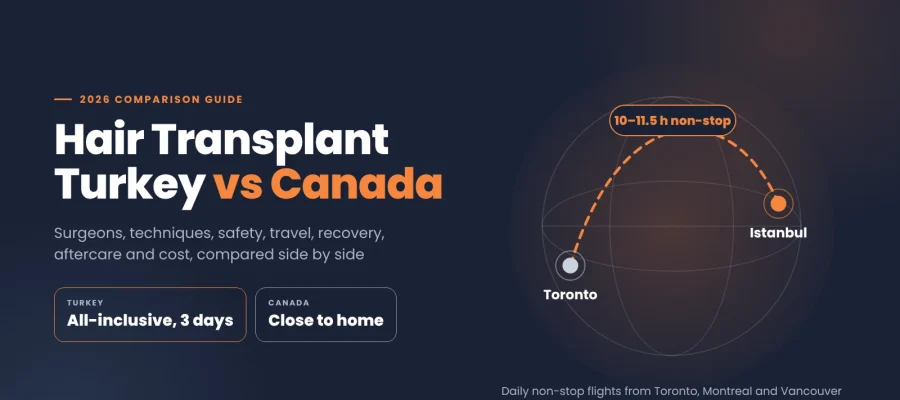
Turkey and Canada can both deliver an excellent hair transplant, but they suit different patients. Turkey usually wins on technique range, experience with large sessions and price, with all-inclusive packages of about CA$2,800 to CA$7,650 against CA$12,500 to CA$24,500 for the surgery alone in Canada. Canada wins on proximity, with no long-haul flight and in-person check-ups a short drive away. In both countries, the result depends on who plans your hairline, who performs the critical steps and how well the clinic is regulated, so those questions matter more than the flag.
I am Dr. Mehmet Erdoğan, co-founder of Smile Hair Clinic in Istanbul, president of SAÇREHDER and a member of FUE Europe and the World FUE Institute, with more than 5,000 hair transplant procedures behind me. Canadians are among the international patients I see most often, and their questions go well beyond price. This page compares the two countries on surgeons, techniques, results, safety, insurance, travel, recovery, long-term planning, aftercare and cost, so you can weigh every side of the decision.
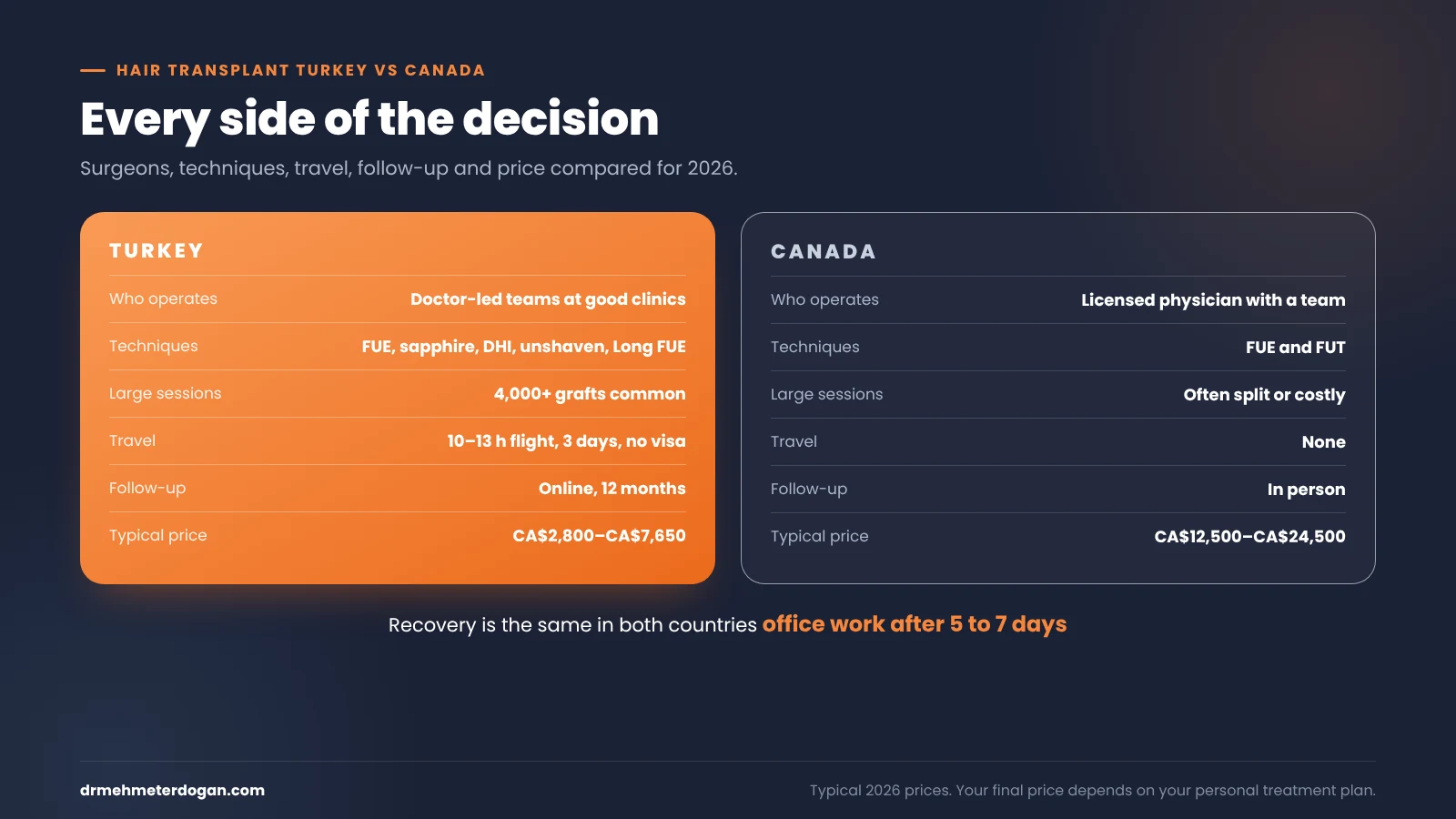
Hair Transplant in Turkey vs Canada at a Glance
The table brings together the factors Canadian patients ask about most. Each one is explained in its own section below.
| Factor | Turkey | Canada |
|---|---|---|
| Who plans and operates | Varies by clinic, from doctor-led teams to technician-heavy centres | A licensed physician with a team |
| Main techniques | FUE, sapphire FUE, DHI, unshaven, Long FUE | FUE and FUT, robotic FUE at some clinics |
| Large sessions, 4,000 grafts or more | Common | Possible, often split or costly |
| Regulator | Ministry of Health | Provincial colleges of physicians and surgeons |
| Provincial health plan coverage | None | None for hereditary hair loss |
| Travel | 10 to 13 hour non-stop flight, about 3 days, no visa | None, or a domestic trip |
| Recovery | Same in both countries, office work after 5 to 7 days | Same in both countries, office work after 5 to 7 days |
| Follow-up | Online, usually for 12 months | In person at the clinic |
| Typical price | CA$2,800 to CA$7,650, all-inclusive | CA$12,500 to CA$24,500, surgery only |
Who Performs Your Hair Transplant in Turkey and in Canada?
This is the single most important question in either country. A hair transplant has three critical steps, the hairline design, the extraction of the grafts and the opening of the recipient channels, which decide the angle, direction and density of the new hair. Placing the grafts and preparing them are usually done by trained teams in both countries, under the surgeon’s supervision.
In Canada, hair transplants are performed by licensed physicians working with a clinical team. In Turkey, the picture is wider. Doctor-led clinics work much like Canadian ones, while some low-cost centres run several operations at once and leave most of the work to technicians. That difference, not the country, explains most of the poor results people see online.
| Question to ask any clinic | A good answer |
|---|---|
| Who designs my hairline? | A named doctor, in person, before the operation |
| Who extracts the grafts? | A doctor, or a team supervised by a named doctor in the room |
| Who opens the recipient channels? | A named doctor |
| How many patients does each doctor treat a day? | A small, stated number |
| Can I speak with my doctor before booking? | Yes, during the online or in-person consultation |
At Smile Hair Clinic, each doctor operates on no more than two patients a day, and the clinic is the only hair transplant clinic in Turkey and in the world with TEMOS A-Rating accreditation. In our Platinum package, the incisions are made by Dr. Ali Osman Soluk or Dr. M. Reşat Arpacı, and in Diamond, the consultation, planning and incisions are carried out by Dr. Gökay Bilgin, myself or our head doctor Dr. Firdavs Ahmedov.
Which Hair Transplant Techniques Are Available in Each Country?
FUE is the standard method in both countries. The difference is breadth. Turkish clinics that focus on hair restoration use several FUE variations every day, while many Canadian clinics still perform FUT, the strip method, which removes a band of skin from the back of the head and leaves a linear scar.
| Technique | What it is | Who it suits | Turkey | Canada |
|---|---|---|---|---|
| FUE | Grafts taken one by one from the donor area | Most patients | Standard | Standard |
| Sapphire FUE | FUE with channels opened by sapphire blades | Dense packing, faster healing | Widely used | At some clinics |
| DHI | Grafts placed with an implanter pen | Hairlines and denser zones | Widely used | At some clinics |
| Unshaven FUE | Operation without shaving the whole head | Patients who need to stay discreet | Widely available | Limited |
| Long FUE | Grafts transplanted with the hair left long | Previewing the result on day one | Available at specialist clinics | Rare |
| FUT | A strip of scalp removed and divided | Selected cases | Rarely performed | Still common |
Canada is one of the most diverse countries in the world, and hair type matters when choosing a technique. Curly and coily hair curves under the skin as well as above it, so extraction needs particular care, which is explained on the afro hair transplant page. Women with thinning hair are assessed differently from men, as described on the female hair transplant page.
What Results Can You Expect in Turkey and in Canada?
A transplanted hair grows for life, because grafts taken from the back of the head are resistant to the hormone that causes androgenetic alopecia. What decides how good the result looks is planning. That means the number of grafts your donor area can safely give, a hairline that suits your age and face, and enough density in the zones people see first.
The donor area is limited, which is why a first operation should be planned with your future hair loss in mind. A hairline that looks right at 28 should still look natural at 50. In Turkey, large sessions of 4,000 grafts or more in one day are common and do not change the package price. In Canada, larger plans are possible but often split into two sessions or priced so high that patients accept fewer grafts than they need.
Nirmal travelled from Canada for a 5,150-graft operation with Dr. Gökay Bilgin. In the video below, he talks about how he made his decision and how he felt from consultation to aftercare.
How Safe Is a Hair Transplant in Turkey Compared With Canada?
FUE is a low-risk operation under local anaesthesia, and its medical risks are the same wherever it is performed. Safety depends on licensing, sterile conditions and the experience of the people in the room. Both countries have clear rules, and in both countries the patient’s job is to check that a clinic follows them.
In Canada, doctors are licensed by the college of physicians and surgeons in their province, for example the CPSO in Ontario, and patients can look up a doctor on the college’s public register. In Turkey, the Ministry of Health licenses clinics and doctors, hair transplants must be performed in licensed health facilities, and clinics treating international patients need a separate health tourism authorisation certificate.
| Turkey | Canada | |
|---|---|---|
| Doctor licensing | Ministry of Health | Provincial college of physicians and surgeons |
| Facility licensing | Ministry of Health | Provincial rules, which vary by province |
| International patient authorisation | Required for health tourism providers | Not applicable |
| Independent accreditation | Available, for example TEMOS or JCI | Available at some clinics |
| How to check a clinic | Ask for the Ministry licence, the health tourism certificate and your doctors’ names | Check the surgeon on the provincial college register |
The long flight home is safe after FUE, since there is no large wound and no general anaesthesia. Walking in the aisle, drinking water and avoiding alcohol on the flight help keep circulation moving and reduce swelling. In the ABC News Nightline documentary below, an American patient travels to Istanbul for his operation with Dr. Gökay Bilgin & Dr. Mehmet Erdoğan, and the programme follows him for a year to look at whether going abroad was the right decision.
Does Provincial Health Insurance or Tax Relief Apply?
No provincial plan covers a hair transplant for hereditary hair loss. OHIP, MSP, RAMQ and the other plans treat it as cosmetic surgery, so the patient pays in Canada and in Turkey alike. Provincial plans also give very limited coverage outside Canada, so a travel medical insurance policy for the trip is a sensible addition.
Canada’s medical expense tax credit does not cover purely cosmetic procedures, so a hair transplant for androgenetic alopecia usually cannot be claimed. If your hair loss follows an injury, a burn or an illness, a tax adviser can tell you whether your case is treated differently. Canadian quotes for cosmetic procedures can also have GST or HST added on top.
How Do the Two Countries Compare on Cost?
A typical Canadian hair transplant costs CA$12,500 to CA$24,500, at around CA$5.50 to CA$9.50 per graft, with prices usually highest in Vancouver and Toronto. In Turkey, the same plan normally costs CA$2,800 to CA$7,650, about CA$1.60 per graft on average, and the package covers the hotel, VIP transfers, blood tests, medication, PRP and aftercare.
The gap comes from the pricing model and the economy. Canadian clinics bill per graft, so the price rises with every graft placed. Turkish clinics usually sell fixed packages, operating costs in Istanbul are far lower, and authorised health tourism providers benefit from a VAT exemption for foreign patients. The lower price reflects the market, not a lower standard of surgery.
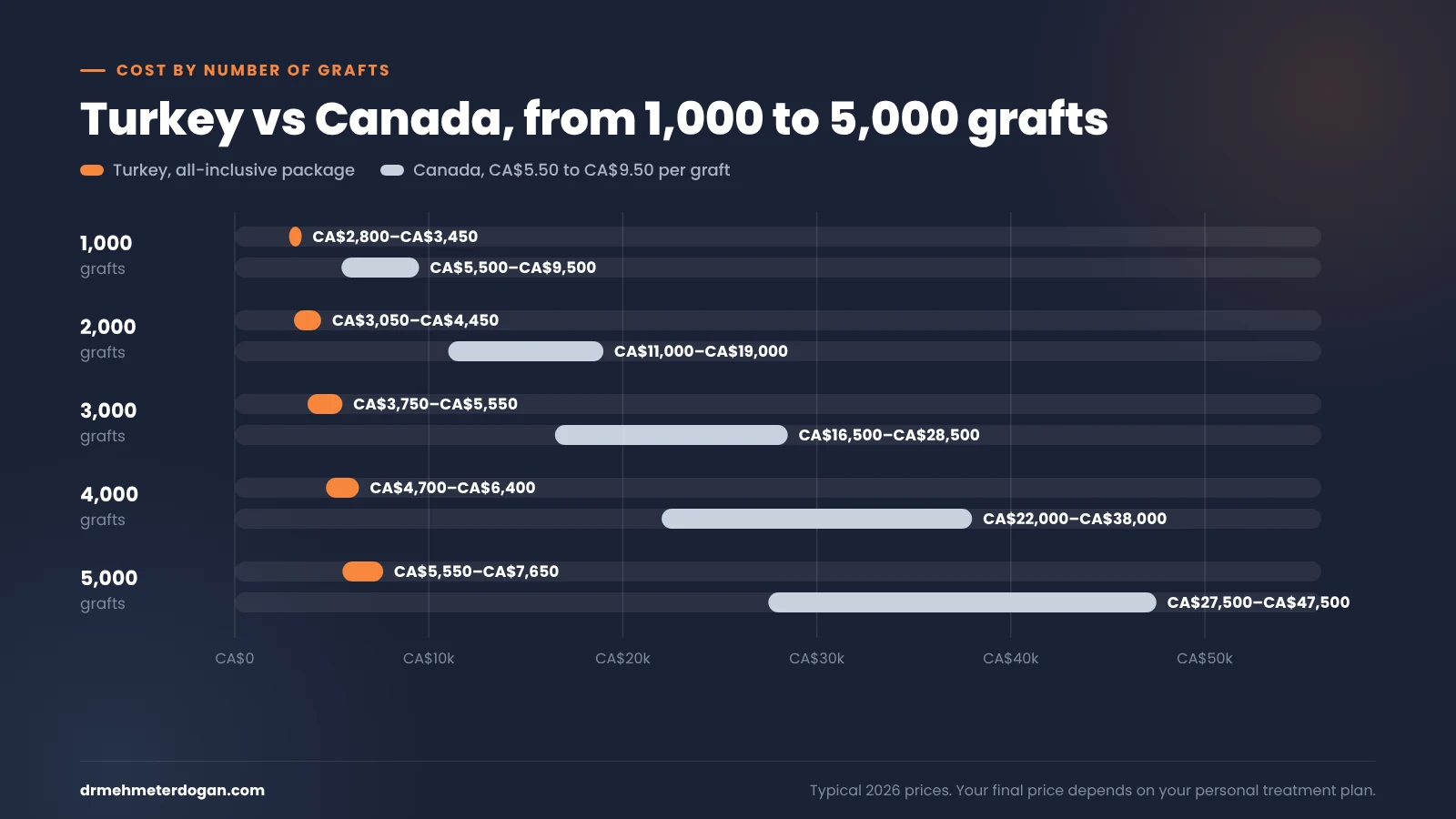
How Does the Price Change With the Number of Grafts?
| Number of grafts | Turkey, all-inclusive | Canada, at CA$5.50 to CA$9.50 per graft |
|---|---|---|
| 1,000 grafts | CA$2,800 to CA$3,450 | CA$5,500 to CA$9,500 |
| 2,000 grafts | CA$3,050 to CA$4,450 | CA$11,000 to CA$19,000 |
| 3,000 grafts | CA$3,750 to CA$5,550 | CA$16,500 to CA$28,500 |
| 4,000 grafts | CA$4,700 to CA$6,400 | CA$22,000 to CA$38,000 |
| 5,000 grafts | CA$5,550 to CA$7,650 | CA$27,500 to CA$47,500 |
What Does the Whole Trip From Canada Cost?
For a 3,000-graft operation, the package, a return flight from Toronto of CA$1,060 to CA$1,560 and meals bring the total to about CA$4,900 to CA$7,300. That leaves a typical saving of CA$9,200 to CA$23,600 compared with the surgery alone in Canada. You can test your own numbers in the calculator on the hair transplant Turkey cost page, and the per-graft picture is on the hair transplant Turkey graft cost page.
What Is the Patient Experience Like in Turkey Compared With Canada?
In Canada, you usually drive to the clinic on the day, go home the same evening and return for check-ups. In Turkey, the trip is organised around you. A driver meets you at the airport, the hotel is booked, a coordinator who speaks English stays with you from arrival to departure, and the first wash is done at the clinic before you fly home.
| Step | Turkey package | Typical Canadian clinic |
|---|---|---|
| Consultation | Online first, then in person on day one | In person, sometimes with a fee |
| Blood tests | Included | Often arranged separately |
| PRP | Included | Often extra |
| Medication and care kit | Included | Often extra |
| First wash | Done at the clinic | Usually done at home |
| Hotel and transfers | Included | Not needed |
Three friends from Canada made the trip together, and their video shows the journey from arrival in Istanbul to the operation. What each Smile Hair Clinic package includes is on the hair transplant Turkey package page.
How Long Is the Trip From Canada to Istanbul?
Turkish Airlines flies daily non-stop from Toronto, Montreal and Vancouver to Istanbul, and Air Transat adds non-stop flights from Toronto and Montreal. Patients from Calgary, Edmonton, Ottawa or Halifax usually connect through one of these three cities. Canadian citizens do not need a visa to visit Turkey for up to 90 days, so a passport valid for your stay is enough.
| From | Non-stop flight time | Time difference with Istanbul |
|---|---|---|
| Toronto | About 10 to 11.5 hours | Istanbul is 7 hours ahead, 8 in winter |
| Montreal | About 10 to 11 hours | Istanbul is 7 hours ahead, 8 in winter |
| Vancouver | About 12 to 13 hours | Istanbul is 10 hours ahead, 11 in winter |
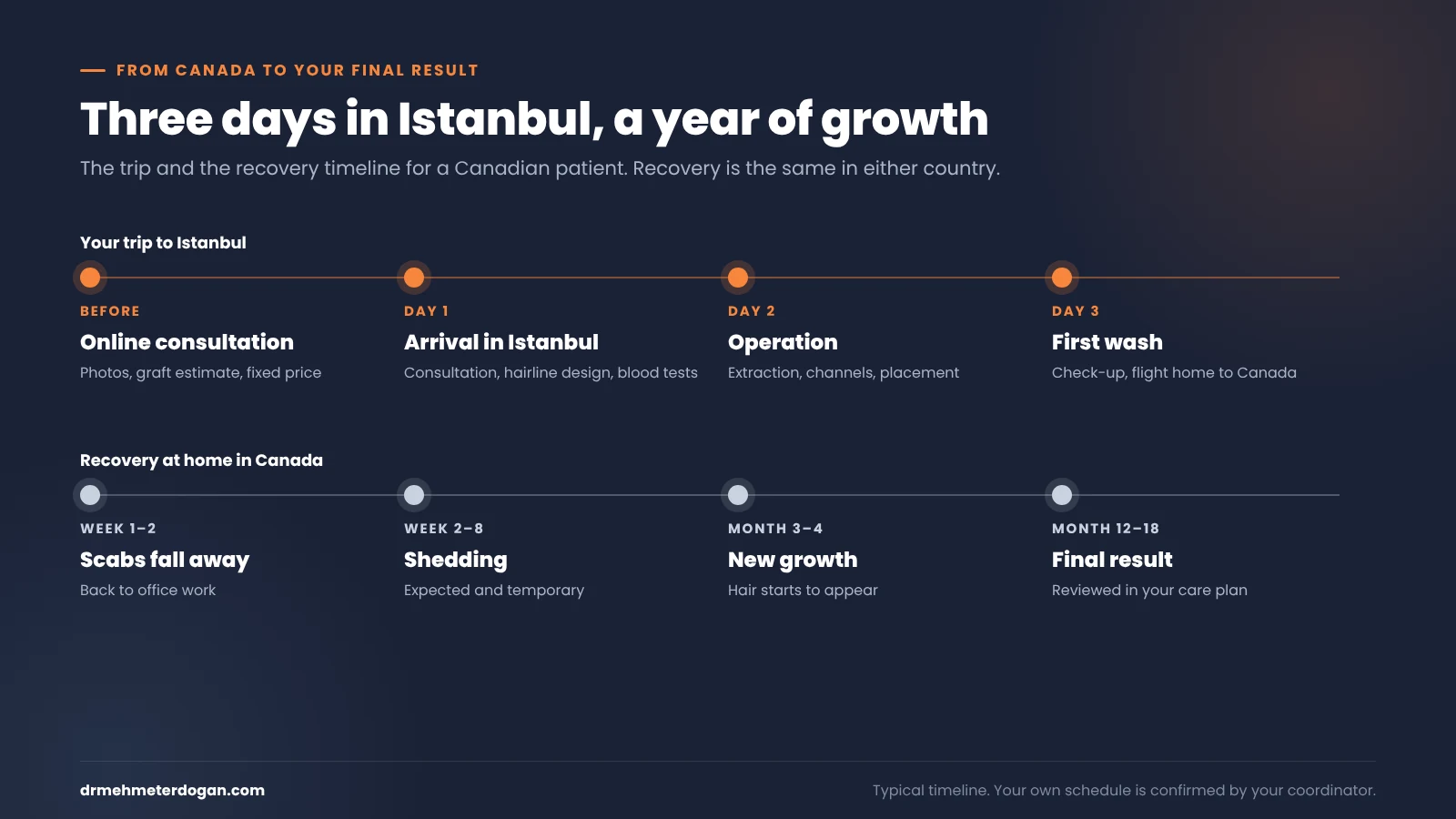
The visit takes about three days, with the consultation and blood tests on the first day, the operation on the second and the first wash on the third. Because of the long flight and the time difference, many Canadian patients arrive a day early or stay an extra night, and some add a few days in Istanbul before the operation.
What Does Recovery Look Like After a Hair Transplant?
Recovery is the same whether the operation takes place in Istanbul or in Toronto. Most patients return to office work within 5 to 7 days and to physical work or the gym after about two weeks. The scabs fall away in the second week, the transplanted hairs shed in the following weeks, and new growth begins around the third or fourth month.
| Time after the operation | What happens |
|---|---|
| Days 1 to 3 | Mild swelling and tightness, first wash at the clinic |
| Days 7 to 14 | Scabs fall away, return to office work |
| Weeks 2 to 8 | Transplanted hairs shed, which is expected |
| Months 3 to 4 | New hair starts to grow |
| Months 6 to 8 | Visible change in density |
| Months 12 to 18 | Final result |
Canadian weather adds a practical point. In winter, the scalp needs protection from the cold without a tight hat pressing on the grafts, and your coordinator will tell you when a loose hat is safe. In summer, keep direct sun off the scalp for the first weeks. Practical aftercare advice is in the patient guide.
How Does Aftercare and Follow-Up Work From Canada?
Having your surgeon a short drive away is the main practical advantage of staying in Canada. After FUE, though, most follow-up is visual and works well remotely. At Smile Hair Clinic, every package includes a 1-year care plan, with photos sent at key stages, your doctor reviewing your progress and your coordinator available in English throughout.
If you ever need an in-person check in Canada, your family doctor or a local dermatologist can examine the scalp and share notes with us. Being clear about this before you book, in either country, is part of choosing a clinic well.
What Happens in the Long Term?
A hair transplant moves hair to where it is needed, but it does not stop hair loss in the areas that were not treated. A good plan therefore looks ten or twenty years ahead, in Turkey and in Canada alike. Finasteride, available on prescription, and minoxidil, available without one, are both used in Canada to protect the native hair, and your doctor can tell you whether they suit you.
| Long-term factor | Turkey | Canada |
|---|---|---|
| Planning for future hair loss | Part of the consultation at a doctor-led clinic | Part of the consultation |
| Supporting treatments | PRP included in most packages, exosome available | PRP available, usually paid per session |
| Medication | Prescribed if suitable | Prescribed by your doctor if suitable |
| A second session, if needed later | Same fixed package price | Charged per graft again |
How Do You Pay for a Hair Transplant in Turkey and Canada?
Canadian clinics usually take payment by card or through medical financing plans spread over several years, with interest. At Smile Hair Clinic, a €250 deposit secures your date, and the balance is paid on the day of the operation. Cash is recommended for the balance, because card payments for it carry a 10 percent surcharge.
Should You Get Your Hair Transplant in Turkey or Canada?
Each country has a clear profile. Turkey suits patients who want a doctor-led team, a wide choice of techniques and a large session at a fixed price, and who can spend three days in Istanbul. Canada suits patients who cannot travel or who want every check-up in person.
| Your situation | Better fit |
|---|---|
| You need 3,000 grafts or more in one session | Turkey |
| You want sapphire FUE, DHI, unshaven or Long FUE | Turkey |
| You want to avoid a linear FUT scar | Turkey |
| You want a fixed, all-inclusive price | Turkey |
| You cannot take a long-haul flight | Canada |
| You want every follow-up visit in person | Canada |
Some Canadians also look at Mexico because it is closer. That comparison is on the hair transplant Turkey vs Mexico page, and a broader guide is on the hair transplant in Turkey page.
Smile Hair Clinic Packages for Canadian Patients
We work with three all-inclusive packages, Gold (€2,390, about CA$3,800), Platinum (€3,290, about CA$5,250) and Diamond (€5,790, about CA$9,250). The packages differ in who carries out the critical steps. In Gold, the incisions are made by our surgical team, in Platinum by Dr. Ali Osman Soluk or Dr. M. Reşat Arpacı, and in Diamond the consultation, planning and incisions are carried out by Dr. Gökay Bilgin, myself or Dr. Firdavs Ahmedov. Each package covers the operation, blood tests, PRP, medication, hotel nights, VIP transfers, the first wash and the 1-year care plan, and the price does not change with the number of grafts.
Frequently Asked Questions About Hair Transplant in Turkey vs Canada
Are hair transplants in Turkey as good as in Canada?
In a licensed, doctor-led clinic, yes. Turkey has far more clinics dedicated to hair restoration and wider access to sapphire FUE, DHI and unshaven techniques.
Who actually performs the operation in Turkey?
It depends on the clinic. Ask who designs the hairline, extracts the grafts and opens the channels, and expect named doctors in the answer.
Is FUT still used in Canada?
Yes, many Canadian clinics still perform it. Turkish clinics work almost entirely with FUE, which leaves no linear scar.
Is it safe to fly home to Canada after a hair transplant?
Yes. FUE leaves no large wound, and most patients fly home the day after the operation.
Do Canadians need a visa for Turkey?
No. Canadian citizens can stay up to 90 days without a visa.
How long should I stay in Istanbul?
About three days, and many Canadian patients add a night to recover from the flight.
When can I go back to work in Canada?
Most patients return to office work in 5 to 7 days, and to physical work after about two weeks.
How does follow-up work once I am back home?
Follow-up is online, with photos reviewed by your doctor for 12 months, and a local doctor can examine you if needed.
Does OHIP or any provincial plan cover a hair transplant?
No. Hair transplants for hereditary hair loss are considered cosmetic and are not covered in Canada or abroad.
How much can a Canadian save in Turkey?
Typically 63 to 81 percent, or about CA$9,200 to CA$23,600 for 3,000 grafts including the flight.
Planning Your Hair Transplant From Canada With Dr. Mehmet Erdoğan
The right choice is the one where you know exactly who will operate on you, which technique suits your hair, how follow-up will work and what you will pay. Send me your photos, and our team will assess your donor area, estimate your graft count, recommend a technique and give you a fixed price in writing, so you can compare it with any Canadian consultation on every point that matters. You can reach me through the contact page.