


Male pattern baldness is a genetic sensitivity of certain scalp follicles to DHT, a hormone made from testosterone. Over years, DHT shrinks the follicles at the hairline, temples and crown until they grow only fine, short hairs, while the back and sides of the scalp stay protected. It progresses in predictable stages, and the best time to act is when you first recognise the pattern, not when it is advanced.
What is male pattern baldness?
Male pattern baldness is the everyday name for androgenetic alopecia, the most common type of hair loss in men. A 2020 review of male pattern hair loss estimates it affects up to 80% of men by the age of 80. It is not a disease of the whole scalp: it follows a defined pattern, starting at the temples, the frontal hairline or the crown.
The word “pattern” matters. When a patient tells me “my hair is falling out”, my first job is to check whether it is this pattern or something else entirely, such as stress-related shedding. The treatment for the two is very different.
What causes male pattern baldness?
Three things work together: hormones, genes and time.
DHT (dihydrotestosterone)
An enzyme called 5-alpha reductase converts testosterone into DHT. In genetically sensitive follicles, DHT shortens the growth phase and shrinks the follicle a little more with each cycle. The evidence is strong: men who are born with a 5-alpha reductase deficiency, and men castrated before puberty, do not develop pattern baldness, as this review of androgens and alopecia explains. Your testosterone level is usually normal; what differs is how sensitive your follicles are to DHT.
Genetics
Pattern baldness is polygenic: many genes contribute, not a single “bald gene”, according to a review of the physiology of alopecia. The androgen receptor (AR) gene sits on the X chromosome, which you inherit from your mother. That is where the “it comes from your mother’s father” idea comes from. It is only part of the story, though, because many other genes on non-sex chromosomes are involved, and the genetic picture differs between populations, as a 2025 genetic study of African men showed. In practice I ask about both sides of the family.
Time
In the study that created the classification surgeons still use, Dr. O’Tar Norwood examined 1,000 men and found that baldness keeps progressing with age, even in later decades. This is why I always plan for the hair you will have at 50, not only the hair you have today.
It is just as useful to know what does not cause it: wearing a cap, washing your hair daily, using gel or “blocked pores” do not cause male pattern baldness.
Miniaturisation: how pattern hair loss actually happens
Most men expect baldness to mean hair falling out. In my patients I see it happen in two ways. In the first, the hair becomes thinner and thinner — we call these miniaturised hairs. In the second, the hair falls out completely. Both end in the same place: the hairline loses its structure and the area loses density.
Miniaturisation is good news and bad news. The good news is that a thin, miniaturised hair still has a living follicle, and medical treatment can often thicken it again. The bad news is that once a follicle has stopped producing visible hair for years, no tablet or lotion brings it back.
Male pattern baldness stages: the Norwood scale
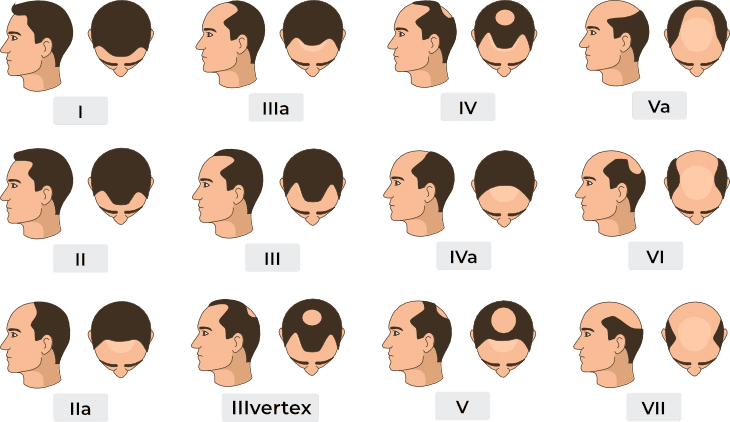
Surgeons describe male pattern baldness with the Hamilton–Norwood scale, which runs from stage 1 to stage 7. Here is how I read each stage in consultation.
| Stage | What you see | What it usually means for you |
|---|---|---|
| Norwood 1 | No real recession; adult hairline | Nothing to treat; watch for change |
| Norwood 2 | Slight recession at the temples | Often a normal mature hairline; monitor |
| Norwood 3 | Clear, deep temple recession (3 vertex: crown thinning too) | First true balding stage; medical treatment window |
| Norwood 4 | Deeper frontal loss plus a bald spot on the crown, separated by a band of hair | Medication to protect what you have; transplant planning can begin |
| Norwood 5 | The band between front and crown thins | Transplant with donor budgeting; front usually has priority |
| Norwood 6 | Front and crown merge into one bald area | Large-session transplant; realistic density goals |
| Norwood 7 | Only a horseshoe of hair at the back and sides | Limited donor; careful prioritisation, sometimes body hair |
Each stage needs a different number of grafts, and the graft count is what drives the price of a procedure. I explain how that works in how hair transplant graft cost is calculated.
One thing patients ask me every week: “Why is one side worse than the other?” In my experience, recession is never perfectly symmetric. Even when the two sides look close, there are differences. That is normal, and it is one reason a natural hairline is designed by eye and proportion rather than with a ruler.
How I diagnose male pattern baldness in consultation
A diagnosis takes a few minutes, but it decides everything that follows. My routine has four parts.
- History. When did it start, how fast is it moving, and who in the family is bald and at what age? I also ask about recent illness, rapid weight loss, new medication and stress, because these trigger temporary shedding.
- Pattern. I look at the hairline, temples, mid-scalp and crown, dry and under strong light. Longer hair can hide a lot; I have seen patients whose studio photos looked fuller than what I found once the hair was short.
- Trichoscopy. With a dermatoscope I look at the hair shafts at high magnification. In pattern baldness the typical finding is hair diameter diversity: thick and miniaturised hairs side by side in the affected area, as a systematic review of trichoscopy describes. Peripilar signs and areas without follicles support the diagnosis.
- Donor assessment. I examine the back and sides of the scalp, because that “safe donor zone” decides what a transplant can achieve later.
If the history or pattern does not fit, I order blood tests before going further. Iron stores, vitamin D and thyroid problems can all thin the hair, so I rule them out first.
Is it really male pattern baldness? Conditions I rule out
Several conditions look like pattern baldness but behave differently, and some resolve without treatment:
- Diffuse shedding after illness, surgery or stress (telogen effluvium), which usually settles within months.
- Shedding after rapid weight loss or GLP-1 medication such as Ozempic or tirzepatide.
- Hair loss in women, which follows a different pattern and has different causes; when surgery is an option, it is planned differently, as I explain in hair transplant for women.
Shedding conditions usually affect the whole scalp evenly and often recover within months. Pattern baldness does not recover on its own.
When to act: the three decision points I use
Decision point 1: early loss (Norwood 2–3), protect what you have
This is the stage where medical treatment does the most. A large review concludes that finasteride and minoxidil can slow or stop progression, regrowth is partial at best, and early treatment gives a better outcome. In a five-year follow-up of 126 men on finasteride, 85.7% had improved. Medication needs a doctor’s prescription and follow-up. In-clinic options such as PRP hair treatment, hair mesotherapy and exosome hair therapy can support the scalp alongside it.
Decision point 2: an established, stable pattern, consider a transplant
I do not operate on hair loss that is moving fast. The underlying cause has to be evaluated and treated first; when the loss is stable, a transplant can be planned. Young patients asking me to rebuild their temple points hear the same caution: if the recession continues behind the transplanted hairs, a gap opens and a second procedure becomes necessary. If you are travelling for surgery, read what a hair transplant in Turkey involves before you book anything.
Decision point 3: advanced loss (Norwood 5–7), budget the donor
Here the limit is not the bald area but the donor area. The safe donor zone holds hairs that are resistant to DHT and stay permanent after transplantation. In many patients that zone alone gives around 2,000–2,500 grafts. Larger sessions of 4,000 grafts or more need hairs from just outside it, which are more prone to future loss, so I advise these patients to stay on medication afterwards.
The arithmetic is simple. Lowering an 18 cm-wide hairline by just 1 cm adds 18 cm² of skin; at around 55 follicular units per cm², that is about 1,000 grafts for one centimetre. When a patient’s total donor capacity is around 7,000–8,000 grafts, every centimetre has to be justified. When the scalp donor runs short at Norwood 6–7, beard and body hair grafts can extend it. At this stage a Sapphire FUE hair transplant with a surgeon-designed hairline is usually the main option, combined with medication.
Can male pattern baldness be reversed?
Partly, and only while the follicles are still alive. Medication can thicken miniaturised hairs and slow the process, but it does not restore an area that has been bald for years. A transplant does not reverse the condition either; it moves DHT-resistant follicles from the back of the scalp to where they are needed. Those transplanted hairs keep the resistance of their origin, which is why the result is permanent, while your native hairs around them can keep thinning.
Dr. Erdoğan’s Bottom Line: Act on the Pattern, Not the Panic
Male pattern baldness is predictable, and that is your advantage. Identify your stage, rule out shedding conditions, and protect your existing hair early. Consider a transplant only when the loss is stable and your donor area can deliver what you want, not just today but for the next twenty years.
If you are unsure where you stand, send me clear photos of your hairline, temples, crown and donor area. I would rather tell you to wait than operate too early.
Considering a Hair Transplant in Turkey?
If your hair loss has stabilised and you are ready to restore your hairline, the next step is a personal assessment of your Norwood stage and donor capacity. Start with how I plan and perform hair transplants in Turkey, then see what a hair transplant in Turkey costs and what is included in the hair transplant package. Send me photos of your hairline, crown and donor area, and I will tell you honestly whether now is the right time.
Frequently Asked Questions
Is male pattern baldness genetic?
Yes. It is polygenic, meaning many genes contribute from both your mother’s and your father’s side [3][4]. A bald father or maternal grandfather raises your risk but does not guarantee baldness.
At what age does male pattern baldness start?
It can begin any time after puberty, and in some men the first temple recession appears in their late teens or twenties. It tends to progress with age [5].
Will a hair transplant stop male pattern baldness?
No. Transplanted hairs are resistant, but the native hairs around them can keep thinning. That is why I plan long-term and often combine surgery with medication.
Does wearing a hat cause baldness?
No. A clean, normally fitting cap does not cause pattern hair loss.
This article is for information only and does not replace an in-person medical examination.
References
- York K, Meah N, Bhoyrul B, Sinclair R. A review of the treatment of male pattern hair loss. Expert Opin Pharmacother. 2020;21(5):603–612. doi:10.1080/14656566.2020.1721463
- Kaufman KD. Androgens and alopecia. Mol Cell Endocrinol. 2002;198(1–2):89–95. doi:10.1016/s0303-7207(02)00372-6
- Tai T, Kochhar A. Physiology and medical treatments for alopecia. Facial Plast Surg Clin North Am. 2020;28(2):149–159. doi:10.1016/j.fsc.2020.01.004
- Janivara R, et al. Uncovering the genetic architecture and evolutionary roots of androgenetic alopecia in African men. HGG Adv. 2025;6(3):100428. doi:10.1016/j.xhgg.2025.100428
- Norwood OT. Male pattern baldness: classification and incidence. South Med J. 1975;68(11):1359–1365. doi:10.1097/00007611-197511000-00009
- Kinoshita-Ise M, Sachdeva M. Update on trichoscopy: integration of the terminology by systematic approach and a proposal of a diagnostic flowchart. J Dermatol. 2022;49(1):4–18. doi:10.1111/1346-8138.16233
- Shin JW, et al. Evaluation of long-term efficacy of finasteride in Korean men with androgenetic alopecia using the basic and specific classification system. J Dermatol. 2019;46(2):139–143. doi:10.1111/1346-8138.14719