


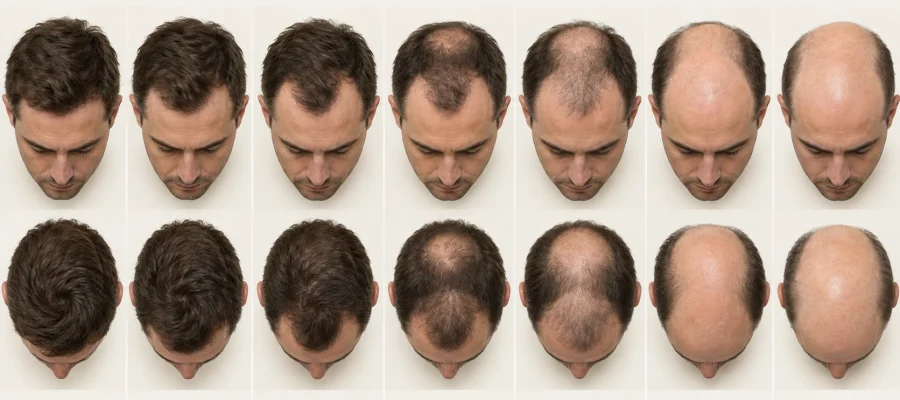
The Norwood scale is the 7-stage system surgeons use to classify male pattern baldness, from Norwood 1 (no real recession) to Norwood 7 (only a horseshoe of hair left at the back and sides). Each stage roughly predicts how large the bald area is, and therefore how many grafts a transplant needs: from around 1,500 at Norwood 3 to 6,000 or more at Norwood 7.
Those numbers are where planning starts, not where it ends. Two men at the same Norwood stage can need very different graft counts, because hair calibre, donor density and the hairline they want all change the arithmetic. Below, each stage is explained the way it is assessed in consultation at Smile Hair Clinic, with real cases and the graft counts that were actually used.
What is the Norwood scale?
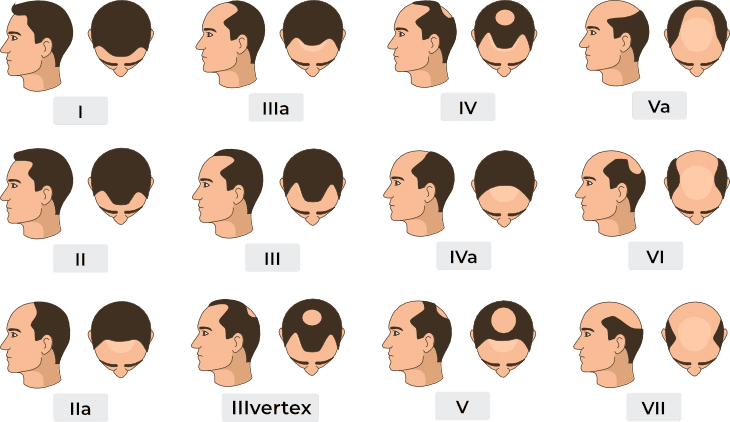
The Norwood scale, also called the Hamilton–Norwood scale, grades male pattern hair loss by where the hair is lost and how far the loss has spread. Dr. James Hamilton published the first version in 1951. Dr. O’Tar Norwood refined it in 1975 after classifying 1,000 men, adding the vertex and “class A” variants that are still in use.
Surgeons use it for three practical reasons:
- A shared language. “Norwood 4” tells another surgeon, or a patient comparing clinics, roughly what the scalp looks like.
- A starting point for graft planning. Each stage corresponds to a typical size of bald area in square centimetres, which is what grafts are calculated from.
- A sense of direction. Hair loss usually moves through the stages in order, so the scale also hints at what may come next.
The scale has limits. It describes shape, not density, and it does not fit women well; a 2007 study proposing the BASP classification was developed partly for that reason. In practice, the Norwood stage is the first line of a consultation, never the last.
Norwood stages and graft numbers at a glance
The table below gives the typical planning range for a full restoration at each stage. Your own number depends on the factors explained further down.
| Norwood stage | What you see | Typical graft range |
|---|---|---|
| Norwood 1 | Adult hairline, no real recession | No transplant needed |
| Norwood 2 | Slight, symmetrical recession at the temples | Usually none; 500–1,000 if treated |
| Norwood 3 | Deep temple recession forming an “M” | 1,500–2,500 |
| Norwood 3 vertex | Norwood 3 front plus thinning on the crown | 2,000–3,000 |
| Norwood 4 | Deeper front loss and a bald crown, separated by a band of hair | 2,500–3,500 |
| Norwood 5 | The band between front and crown thins out | 3,500–4,500 |
| Norwood 6 | Front and crown merge into one bald area | 4,500–6,000 |
| Norwood 7 | Only a horseshoe of hair at the back and sides | 6,000+ (limited by donor) |
To see how these counts translate into a price, read how hair transplant graft cost is calculated.
The Norwood stages explained one by one
Norwood 1: the adult hairline
There is no meaningful recession. The hairline may sit slightly higher than it did in your teens, which is normal maturation. Nothing needs treating; this is simply the baseline to compare against later.
Norwood 2: early temple recession
The temples recede slightly and evenly, usually by less than 2 cm. Many men stay at Norwood 2 for life, and on its own it is often a mature hairline rather than balding. I rarely recommend surgery here. If the recession is moving, medical treatment and scalp treatments such as PRP hair treatment or hair mesotherapy are the first step. When a patient does want the temples refined, the session is small, often 500–1,000 grafts, and can sometimes be done as an unshaven hair transplant.
Norwood 3: the first true balding stage
The temples recede deeply and the hairline takes on a clear “M” or “V” shape. This is the earliest stage that counts as male pattern baldness, and the most common one I see in men in their twenties and early thirties. A typical restoration needs 1,500–2,500 grafts.
The key decision at Norwood 3 is how low to bring the hairline. Every centimetre counts: on an 18 cm-wide hairline, lowering it by 1 cm adds 18 cm² of skin, and at about 55 follicular units per cm² that is roughly 1,000 extra grafts. Young patients also need a plan for future loss, because native hair behind a new hairline can keep receding.
Norwood 3 vertex: temples plus the crown
The front looks like Norwood 3, but the crown has started to thin as well. Expect 2,000–3,000 grafts if both areas are treated. Many surgeons, myself included, prioritise the front and treat the crown medically first, because crown loss tends to keep expanding and grafts placed there have to keep pace with it.
Norwood 4: two separate bald areas
The frontal recession is deeper and the crown is clearly bald, but a band of hair still separates them. Typical range: 2,500–3,500 grafts. This band is valuable: as long as it holds, it frames both areas and makes the result look fuller.
Norwood 5: the bridge thins
The band between the front and the crown becomes thin and narrow. From the side, the bald area already has the classic horseshoe outline. Typical range: 3,500–4,500 grafts. At this stage donor budgeting begins in earnest, and the front and mid-scalp usually get priority over the crown.
Norwood 6: front and crown merge
The band is gone and the whole top of the scalp is one bald area. Typical range: 4,500–6,000 grafts, usually in one large session or two sessions. The goal is coverage with a natural hairline, not the density of a teenager.
Norwood 7: the horseshoe
Only a narrow horseshoe remains at the sides and back, and it is often thinner than in earlier stages. Typical range: 6,000+ grafts, but the real limit is what the donor area can safely give. When scalp donor runs short, beard and body hair grafts can extend it.
What the “A” variants mean
In the class A variants (2A, 3A, 4A and 5A), the hairline moves back evenly from front to back instead of forming the “M” shape, and there is no separate crown spot. Class A patterns are less common, but they can look more advanced than they are because the front is affected first. Planning follows the same logic: measure the bald area, then convert it into grafts.
Why graft numbers are ranges, not fixed figures
The Norwood stage tells me the size of the area. The graft count comes from four other things I measure in consultation.
Hair calibre and hairs per graft
A graft is a follicular unit, and it can hold one, two, three or four hairs. Thick, multi-hair grafts cover far more scalp than thin, single-hair grafts. I have had patients where 3,000–4,000 grafts gave better coverage than a much larger session in someone else, simply because their hair was coarser. The number of grafts matters less than the ratio of multi-hair grafts and the thickness of each hair.
Donor capacity
The safe donor zone at the back and sides holds hairs that resist DHT and stay permanent after transplantation. In many patients that zone alone gives around 2,000–2,500 grafts. Sessions of 4,000 grafts or more need hairs from just outside it, which are more likely to thin in the future, so those patients usually stay on medication afterwards. Total lifetime donor capacity varies widely; in one recent consultation I estimated around 7,000–8,000 grafts for a patient with average density.
For very fine hair I use smaller punches, from 0.6 to 0.9 mm in diameter, so more grafts can be extracted from each square centimetre without the extraction sites sitting too close together.
Hairline position and density goal
A lower hairline means a larger area, and the frontal third needs the highest density because it frames the face. Further back, density can be lower without looking thin. Two patients at Norwood 5 can therefore need very different counts depending on where the hairline is drawn. I always design it with the patient, but I am against bringing it too low, because every graft spent on the forehead is a graft not available for the mid-scalp and crown.
Future hair loss
A graft count that restores today’s bald area may not cover the area that is bald in ten years. For younger patients I plan with that in mind, keep a donor reserve for later, and recommend medication to protect the native hair around the transplant.
One session or two?
If the donor area can safely give the grafts in one day without damage, I prefer a single, maximum-effort session for patients who travel to Istanbul. It spares them a second trip and a second year of waiting for growth. When the plan needs more than the donor can give at once, or the crown needs more work after the front has grown, a second session is planned.
Real cases: how many grafts each patient actually needed
These four patients show how stage, hair type and goals turn into a final number.
Early recession, 2,700 grafts
A 23-year-old with a low Norwood stage wanted his hairline lowered, with more work needed on the right side. Because he had dense native hair behind the hairline, the new hairline had to match that density; a lower density at the front would have looked unnatural against the thick hair behind it. His existing hairs were kept inside the new line to make the transition seamless.
Norwood 5, 4,800 grafts
A 31-year-old patient from Italy had a receded hairline, deep temple recession, miniaturised hair at the front and a thinning crown. We prioritised the hairline, both temples and the crown, and added grafts between existing hairs in the frontal area without damaging them. At twelve months the hairline looked natural even at close range.
Front, mid-scalp and crown, 5,050 grafts
The frontal area alone measured about 40 cm², which needs at least 2,000 grafts. The rest went to the mid-scalp and crown. His forehead narrows slightly, so we chose a rounded hairline rather than a straight one, which suited his face better.
Advanced loss with fine hair, 6,700 grafts
A 30-year-old had used finasteride and minoxidil without improvement. His hair was very fine, including in the donor area, so we extracted the maximum safely possible: 6,700 grafts holding roughly 8,000 hairs, using small punches. The front and mid-scalp were fully restored at twelve months; the crown, which always responds more slowly, may need a second session, which we discussed with him before surgery.
Dr. Erdoğan’s Take: Your Stage Is a Starting Point, Not a Quote
Knowing your Norwood stage helps you understand where you are and what is realistic. It does not give you your graft number. That comes from measuring the area, checking your donor density and hair calibre, and agreeing on a hairline that will still look right in twenty years.
Be cautious of any quote that is based on a stage alone, especially one that promises a very high number without looking at your donor area. A smaller, well-planned session often looks better than a large one that leaves nothing in reserve.
The Norwood scale applies to men; women’s hair loss follows different patterns and is planned differently, as explained in hair transplant for women.
Considering a Hair Transplant in Turkey?
If you know your stage and want a precise plan, the next step is a personal assessment of your donor area and hairline. Read how hair transplants are planned and performed in Turkey, check the hair transplant cost in Turkey, and see what the all-inclusive hair transplant package covers. Send clear photos of your hairline, crown and donor area, and you will get an honest graft estimate.
Frequently asked questions
Is Norwood 2 balding?
Not necessarily. Norwood 2 often describes a normal mature hairline. It becomes balding when the recession keeps moving towards Norwood 3, which is why monitoring with photos every few months is useful.
Is Norwood 3 too late for a hair transplant?
No. Norwood 3 is one of the most common stages for a first transplant. The important point is to plan for future loss, so the new hairline still looks natural if the hair behind it keeps thinning.
How many grafts do I need for Norwood 3?
Usually 1,500–2,500 grafts, depending on how low the hairline is placed and how coarse your hair is. Each centimetre the hairline is lowered can add about 1,000 grafts.
How many grafts do I need for Norwood 5?
Typically 3,500–4,500 grafts. In one Norwood 5 case, 4,800 grafts restored the hairline, temples and crown.
Can Norwood 7 get a hair transplant?
Yes, but expectations must be realistic. The donor area limits what is possible, so the front and mid-scalp usually take priority. Beard or body hair can add grafts when scalp donor is not enough.
This article is for information only and does not replace an in-person medical examination.