


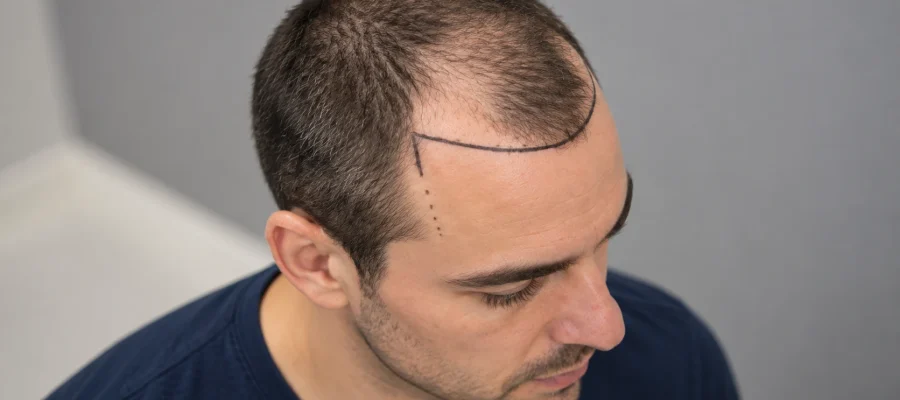
A receding hairline is not always balding. Most men’s hairlines move up by about a finger’s width between their late teens and their twenties, evenly across the front, and then stop. That is a mature hairline. It becomes early balding when the recession keeps moving, deepens at the temples into an “M” shape, and the hairs along the edge turn thin and wispy.
The difference matters, because the two need opposite responses. A mature hairline needs nothing. Early balding responds best to treatment started early, and it is exactly the stage at which a rushed hair transplant can cause problems later. The checklist below is the same one used in consultation at Smile Hair Clinic to tell the two apart.
Juvenile, mature or receding: three hairlines compared
Every man’s hairline goes through at least the first two of these stages. Only some reach the third.
| Juvenile hairline | Mature hairline | Receding (balding) hairline | |
|---|---|---|---|
| Typical age | Childhood and teens | Late teens to late twenties | Any age after puberty |
| Position | Low, often at or near the top forehead crease | About 1–1.5 cm (a finger’s width) above the top crease | Keeps moving back over months and years |
| Shape | Straight or gently rounded | Even, with slight recession at the temples | Deepening “M” or “V” at the temples |
| Hairs at the edge | Thick, same as the rest | Thick, same as the rest | Thin, short, wispy (miniaturised) |
| Movement | Stable | Moves once, then stops | Continues |
What a mature hairline looks like?
A mature hairline sits slightly higher than it did in your teens and the temples soften a little, but the line stays even and the hairs along it are as thick as the hair behind them. On the Norwood scale this usually corresponds to stage 2. Many men keep this hairline for life.
What early balding looks like
Early balding often starts the same way, which is why it is easy to miss. The giveaways are what happens next: the temples keep receding, one side usually faster than the other, and the hairs at the front become thinner and finer before they disappear. When the temple recession becomes deep and clearly “M”-shaped, the hairline has moved into Norwood 3, the first true stage of male pattern baldness.
A surgeon’s checklist: maturation or early balding?
No single sign settles the question. The answer comes from several signs pointing the same way, and from watching what the hairline does over time.
Checks you can do at home
1. The finger test
Raise your eyebrows and place your index finger horizontally above the highest crease on your forehead. If the hairline sits within about one finger’s width (1–1.5 cm) of that crease, it is most likely a mature hairline. If it sits well above it, or the temples cut far back past it, that points to recession beyond maturation.
2. Photos taken the same way, every three months
Take front and side photos with your hair pulled back, in the same light and from the same distance. A mature hairline looks the same from one set to the next. A balding hairline moves. Comparing photos over six to twelve months is more reliable than any single look in the mirror.
3. The hairs along the edge
Look at the front hairs in strong light, ideally when your hair is wet. If they are as thick and dark as the hair behind them, that is reassuring. If there is a fringe of short, fine, almost transparent hairs, those are miniaturised hairs, the earliest visible sign of pattern baldness.
4. The crown
Ask someone to photograph the top and back of your head. Thinning at the crown together with temple recession makes pattern baldness far more likely than maturation alone.
5. Family history
Pattern baldness is strongly inherited from both sides of the family. Ask when your father, grandfathers and uncles started losing hair, and how far it went.
What a surgeon checks in consultation?
Trichoscopy
Under magnification, the hair shafts at the front are compared with those at the back of the scalp. In pattern baldness the typical finding is hair shafts of very different thicknesses side by side, and a study correlating trichoscopic findings with severity found this to be the most common sign in both men and women, visible before the loss is obvious to the eye.
The shape and symmetry of the temples
Recession is never perfectly symmetric; even in a mature hairline the two sides differ slightly. What matters is whether one or both temples keep cutting deeper behind the line of the rest of the hairline.
The donor area
Even at this stage, the back and sides of the scalp are examined. Their density decides what could be done later if the hairline does keep receding.
Why hairlines recede at the temples first?
In male pattern baldness, the follicles at the temples and the front of the scalp are the most sensitive to DHT, a hormone made from testosterone. Under its influence they produce thinner and shorter hairs with each growth cycle until they stop producing visible hair. The follicles at the back and sides are resistant, which is why the loss follows a predictable outline and why those areas serve as the donor for a transplant.
The temple area has a shape of its own. Many men have a small triangle of hair at each temple, and a temple point lower down, in front of the ear. As recession progresses these can fade. When the temple point disappears, the face can look broader at the top even if the central hairline has hardly moved.
Not every receding hairline is pattern baldness. Tight hairstyles such as ponytails or braids can pull hair out along the edge over years, and rare scarring conditions can make the hairline move back along with the eyebrows. If the skin along your hairline looks shiny, scarred or inflamed, or your eyebrows are thinning too, see a doctor rather than assume it is ordinary recession.
What to do about a receding hairline?
If it is a mature hairline
Nothing needs treating. Keep taking photos every few months for a year or two to confirm it has stopped moving. Lowering a mature hairline with surgery is possible, but it is a cosmetic choice, and a young man who does it uses donor grafts he may need later.
If it is early balding
This is the stage where medical treatment does the most, because the follicles are still alive. Finasteride and minoxidil, prescribed and followed up by a doctor, can slow or stop the recession and thicken miniaturised hairs. In-clinic treatments such as PRP hair treatment and hair mesotherapy can support the scalp alongside them. The aim is to protect the hair you have, not to grow back a hairline that has been gone for years.
When a hair transplant makes sense
A transplant is worth considering once the loss has been evaluated, any underlying cause treated, and the hairline has stopped moving fast. Operating on hair loss that is still progressing quickly is one of the most common reasons for disappointing results.
How the new hairline is designed
The hairline is drawn together with the patient, using the proportions of the face, such as the vertical thirds, as a guide. Patients often bring old photos of their hairline, and existing hairs at the front are a useful reference too; where possible they are kept inside the new line so the transition looks seamless. A natural hairline is never a ruler-straight line: small irregularities, single-hair grafts at the very edge and a gradual increase in density behind it are what make it look real. Density also has to match the hair behind it; a thin new hairline in front of dense native hair looks unnatural.
I am generally against bringing the hairline too low. On an 18 cm-wide hairline, every centimetre lower adds roughly 1,000 grafts, and every graft spent on the forehead is one not available for the mid-scalp or crown later. To see how the graft count affects the price, read how hair transplant graft cost is calculated.
Why young patients need extra caution at the temples
Restoring the temple points is one of the most requested changes and one of the most delicate. If the hair loss continues after surgery, the transplanted hairs stay where they were placed while the native hair behind them keeps receding, and a gap opens that needs a second procedure. The temples also need the finest single hairs, placed at a very flat angle and the right direction; if they are not done properly, they are the first thing people notice because they are visible from every angle.
Typical graft numbers for a receding hairline
A hairline-only restoration at an early stage usually needs 1,500–2,500 grafts, more if the hairline is lowered significantly or the temples are rebuilt. In one 23-year-old patient with early recession, 2,700 grafts lowered and rebuilt the hairline to match the dense hair behind it. Small hairline sessions can sometimes be done as an unshaven hair transplant; larger ones are usually performed as a Sapphire FUE hair transplant.
Dr. Erdoğan’s Advice: Watch the Edge, Not Just the Line
The position of your hairline tells you less than the hairs along it and whether it is still moving. An even line that has settled a finger’s width higher, with thick hairs at the edge, is maturity. A line that keeps cutting back at the temples, with fine wispy hairs along it, is early balding, and the earlier you act on it, the more of your own hair you keep.
If you are unsure, a few months of consistent photos and one trichoscopic examination will usually give a clear answer. That is a far better basis for any decision than a single worried look in the mirror.
Considering a Hair Transplant in Turkey?
If your recession has stabilised and you want to restore your hairline or temples, the next step is a personal assessment of your hairline, temples and donor area. Read how hairline restoration is planned in Turkey, compare the hair transplant cost in Turkey, and see what the hair transplant package includes. Send clear photos of your hairline from the front and both sides, and you will get an honest answer on whether now is the right time.
Frequently asked questions
At what age does the hairline mature?
Most men see their hairline mature between their late teens and late twenties. It moves up evenly by about 1–1.5 cm and then stays stable.
Can a receding hairline grow back?
Partly, if treated early. Medication can thicken miniaturised hairs that are still alive, but it cannot regrow a hairline that has been bald for years. Restoring that requires a hair transplant.
Is a receding hairline at 18 normal?
Some even recession at 18 is normal maturation. Deep, uneven temple recession, fine hairs along the edge, or a strong family history of early baldness are reasons to see a doctor.
Should I get a hair transplant for a mature hairline?
Usually not. A mature hairline is not hair loss. Lowering it is a cosmetic choice that uses donor grafts you may need later if balding does start.
How do I stop a receding hairline?
If it is pattern baldness, prescription medication is the most effective way to slow or stop it, ideally started at the first signs. Shampoos, supplements and scalp treatments can support it but do not replace it.
This article is for information only and does not replace an in-person medical examination.
Sources
- Ummiti A, et al. Correlation of trichoscopic findings in androgenetic alopecia and the disease severity. Int J Trichology. 2019. doi:10.4103/ijt.ijt_103_17