


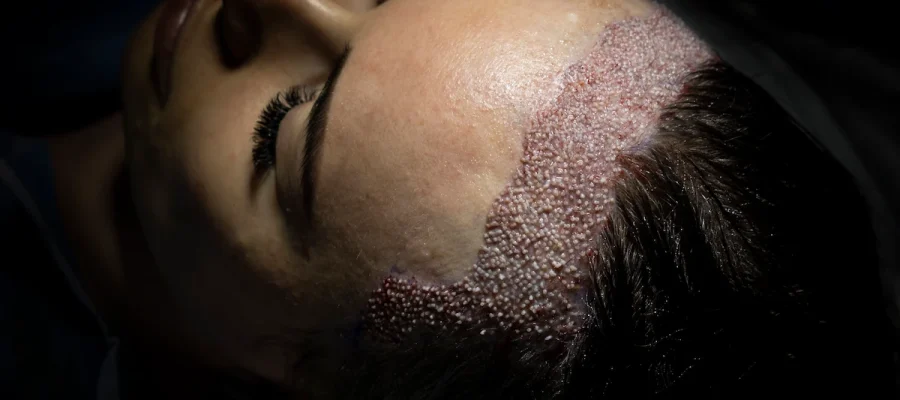
Hair loss in women is common, but it rarely looks or behaves like hair loss in men. The most frequent cause is female pattern hair loss, which thins the hair diffusely across the top of the scalp while usually keeping the front hairline. Other common causes, such as shedding after pregnancy, illness or stress, iron deficiency, thyroid problems and hormonal conditions, are temporary or treatable and need no surgery at all.
That is why a hair transplant is the right answer for some women and the wrong one for many. It works well when the loss is stable and localised and the donor area at the back of the scalp is strong, for example after traction alopecia or with a naturally high hairline. It works poorly when thinning is diffuse across the whole scalp, including the donor area. This guide explains the causes and patterns of female hair loss, and how the decision is made at Smile Hair Clinic, where roughly one in ten hair transplant patients is a woman.
What causes hair loss in women?
The first step with every female patient is a careful medical history, because the same visible thinning can have very different causes. In women these are the most common.
Female pattern hair loss
The female form of androgenetic alopecia is the most common cause of long-term thinning in women. It is genetic and hormone-related, and it progresses slowly over years. Unlike in men, it usually thins the hair across the top of the scalp rather than creating bald areas, and it often becomes more noticeable around menopause.
Shedding after pregnancy, illness or stress
Telogen effluvium is a sudden increase in shedding that typically starts two to three months after a trigger: childbirth, a high fever, surgery, a crash diet or severe stress. The whole scalp sheds evenly and hair usually recovers within months. Postpartum shedding is the most familiar example.
Iron, thyroid and hormonal conditions
Low iron stores, an underactive or overactive thyroid, and hormonal conditions such as polycystic ovary syndrome (PCOS) can all thin the hair. They are found with blood tests and treated at the source; once corrected, the hair often improves.
Traction alopecia
Years of tight braids, ponytails, weaves or extensions can pull hair out along the hairline and temples. Caught early, it recovers when the tension stops. After many years the follicles can be permanently lost, which is one of the situations where a transplant works particularly well.
Alopecia areata and scarring alopecias
Alopecia areata causes round, smooth patches and is autoimmune. Scarring alopecias destroy follicles through inflammation and often cause redness, scaling or itching. Both need a dermatologist’s diagnosis and treatment, and surgery is not an option while they are active.
Patterns of female hair loss
The pattern of loss is the single most important clue, both for the diagnosis and for whether surgery could help.
The Ludwig scale and the widening part
Female pattern hair loss is usually graded on the Ludwig scale, which has three stages: mild thinning on the top of the scalp (I), more obvious thinning (II) and extensive loss over the crown and top (III). The first thing most women notice is a wider parting, often broadest towards the front, while the hairline itself stays in place. Because the Norwood scale used for men fits women poorly, some dermatologists use the BASP classification, designed for both sexes.
How it differs from male pattern baldness
| Women | Men | |
|---|---|---|
| Typical pattern | Diffuse thinning on the top, widening part | Receding temples and a bald crown |
| Front hairline | Usually preserved | Usually recedes |
| Complete baldness | Rare | Common in later stages |
| Donor area | Can thin as well | Usually stable and resistant |
| Main medication | Minoxidil | Finasteride and minoxidil |
Patterns that look like male pattern loss
Some women do lose hair at the temples or along the front hairline. This is most often traction alopecia, or a naturally high hairline and forehead that a woman wants lowered. These localised patterns, with a stable donor area behind them, are the ones that respond best to a transplant.
Diffuse unpatterned thinning
In some women, thinning affects the whole scalp evenly, including the back and sides. This is the pattern that matters most when surgery is considered: if the donor area is thinning too, the transplanted hairs may not be permanent.
Diagnosis and treatment come before surgery
What the assessment includes
- Medical history: when the thinning started, recent pregnancy, illness, weight loss, medication, menstrual changes and family history.
- Blood tests when the history suggests it: iron stores, thyroid function and, where relevant, hormone levels.
- Scalp examination and trichoscopy of both the thinning area and the donor area at the back of the scalp. A donor area that shows the same miniaturised hairs as the top is a warning sign for surgery.
Medical treatment
Topical minoxidil remains the first choice for female pattern hair loss. A 2023 therapeutic review notes it is the only medication with a high level of evidence for women, while around 40% of patients do not respond to it. Low-dose oral minoxidil is increasingly used for women who struggle with the topical form; a review of 17 studies found it effective and well tolerated in healthy patients. Hormone-related treatments are sometimes added, but they need a specialist’s prescription and are not suitable during pregnancy.
Scalp treatments
In-clinic treatments can support medication, particularly in diffuse thinning where surgery is not an option. PRP hair treatment uses growth factors from your own blood, and hair mesotherapy delivers active ingredients directly into the scalp. Results are gradual and need maintenance sessions.
When a hair transplant is (and isn’t) the answer?
A transplant moves hair from the back of the scalp to where it is needed. It only works if the hair at the back is healthy, permanent and plentiful, and if the cause of the loss has stopped.
When a transplant is usually a good option
- Traction alopecia that has caused permanent loss along the hairline or temples, once the tension has stopped.
- A naturally high hairline or large forehead that a woman wants lowered, with a strong donor area.
- Stable female pattern hair loss concentrated at the front or top, with a dense donor area that shows no miniaturisation.
- Scars from surgery, injury or previous procedures, once the scarring condition is inactive.
- Thin or missing eyebrows, which can be restored with an eyebrow transplant.
When a transplant is not the answer
- Diffuse unpatterned thinning that also affects the back and sides of the scalp.
- Active shedding from telogen effluvium, including postpartum shedding, which usually recovers on its own.
- Untreated causes such as iron deficiency or thyroid disease; these are corrected first.
- Active alopecia areata or scarring alopecia.
- Expectations of very high density across a large area; a transplant redistributes hair, it does not add to the total.
How a female hair transplant is planned
At Smile Hair Clinic, a female hair transplant follows the same four steps as for men, with important differences. The hairline is designed differently: a female hairline is softer and more rounded, without the temple recession of a male hairline. Most women do not want to shave their head, so the grafts are usually taken from a small shaved window at the back that is hidden under the surrounding hair, a form of unshaven hair transplant. The channels are then opened at the exact angle and direction of the existing hair, so that the new hair blends in. You can read more about the procedure itself on the female hair transplant page.
A real case: traction alopecia after 20 years
Mara travelled from the United States after more than 20 years of hair loss along her hairline caused by traction. She had no old photos of her original hairline, so we traced it from the faint line of remaining hairs at the front. Because the bald area was large and the number of grafts her donor could give was limited, we placed the new hairline slightly higher and further in than her original one and blended it with the hairs she still had between the two lines. That way the result covers the most visible area naturally, instead of spreading too few grafts over too large an area. Curly and afro-textured hair needs particular care during extraction; see afro hair transplant for how this is done.
Dr. Erdoğan’s View: The Donor Area Decides
For women, the most important question is not how much hair has been lost at the front, but how healthy the hair at the back is. If the donor area is dense and stable, a transplant can restore a hairline, temples or a thinning top with natural, permanent results. If it is thinning as well, surgery risks moving hair that will not last, and medical treatment is the better path.
An honest consultation should be willing to say no. Many women who ask about surgery are better served by finding and treating the cause of their hair loss first, and some of them never need a transplant at all.
Is Your Hair Loss a Candidate for Surgery? Find Out Discreetly

Many women put off asking because they assume a transplant is only for men, or because they do not want to shave their head. A private online assessment answers the first question without any commitment: send photos of your parting, hairline and the back of your scalp, together with any recent blood test results, and you will hear honestly whether surgery, treatment or simply waiting is right for you. If a transplant is the answer, see how a hair transplant in Turkey is planned for women, what a female hair transplant in Turkey costs, and what the hair transplant package includes for your stay.
Frequently asked questions
Can women get hair transplants?
Yes. Around one in ten hair transplant patients at Smile Hair Clinic is a woman. The key requirements are a stable cause of hair loss and a healthy donor area at the back of the scalp.
Do women have to shave their head for a hair transplant?
Usually not. Grafts are typically taken from a small window at the back of the scalp that is hidden by the surrounding hair, so the procedure is barely visible afterwards.
How many grafts does a woman need?
It depends on the area. In recent female cases at the clinic, sessions have ranged from about 1,700 to 3,200 grafts, mostly for the hairline, temples and front of the scalp.
Will my hair grow back after postpartum shedding?
In most cases, yes. Postpartum shedding usually settles within months without treatment. If thinning persists beyond a year, it is worth checking for an underlying cause or female pattern hair loss.
Is female pattern hair loss permanent?
It is a long-term, slowly progressive condition, but treatment can slow it and often thicken existing hair. Starting early gives the best results.
This article is for information only and does not replace an in-person medical examination.
Sources
- Müller Ramos P, et al. Female-pattern hair loss: therapeutic update. An Bras Dermatol. 2023;98(4):506–519. doi:10.1016/j.abd.2022.09.006
- Randolph M, Tosti A. Oral minoxidil treatment for hair loss: a review of efficacy and safety. J Am Acad Dermatol. 2021;84(3):737–746. doi:10.1016/j.jaad.2020.06.1009
- Lee WS, et al. A new classification of pattern hair loss that is universal for men and women: basic and specific (BASP) classification. J Am Acad Dermatol. 2007;57(1):37–46. doi:10.1016/j.jaad.2006.12.029