


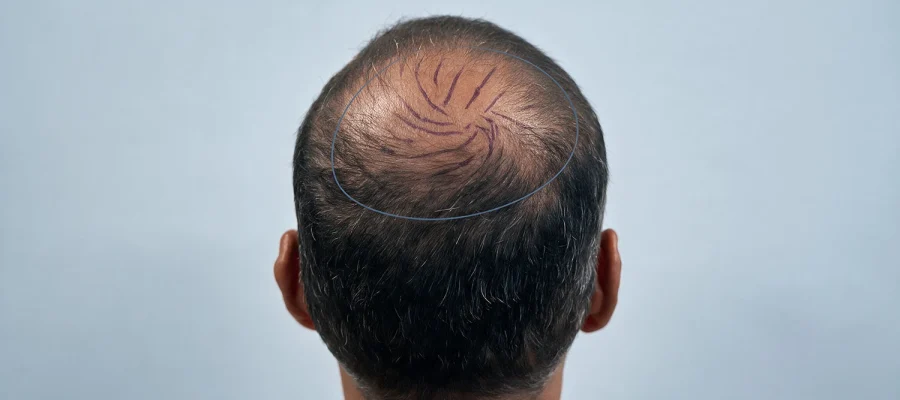
A bald spot on the crown is most often the first sign of male pattern baldness at the top of the head, where the hair grows in a whorl. It usually starts as thinning around the whorl, widens slowly over years, and can eventually merge with a receding hairline. Less often, a round, smooth bald patch that appears within weeks is alopecia areata, a different condition with a different treatment.
The crown is also the area that responds differently to treatment. Medication tends to work well there, while a hair transplant is harder to get right than at the hairline, because the crown keeps expanding and has its own blood supply and hair direction to deal with. This guide explains what causes a bald spot on the crown, how to recognise it early, and how each treatment option is used in practice at Smile Hair Clinic.
What causes a bald spot on the crown?
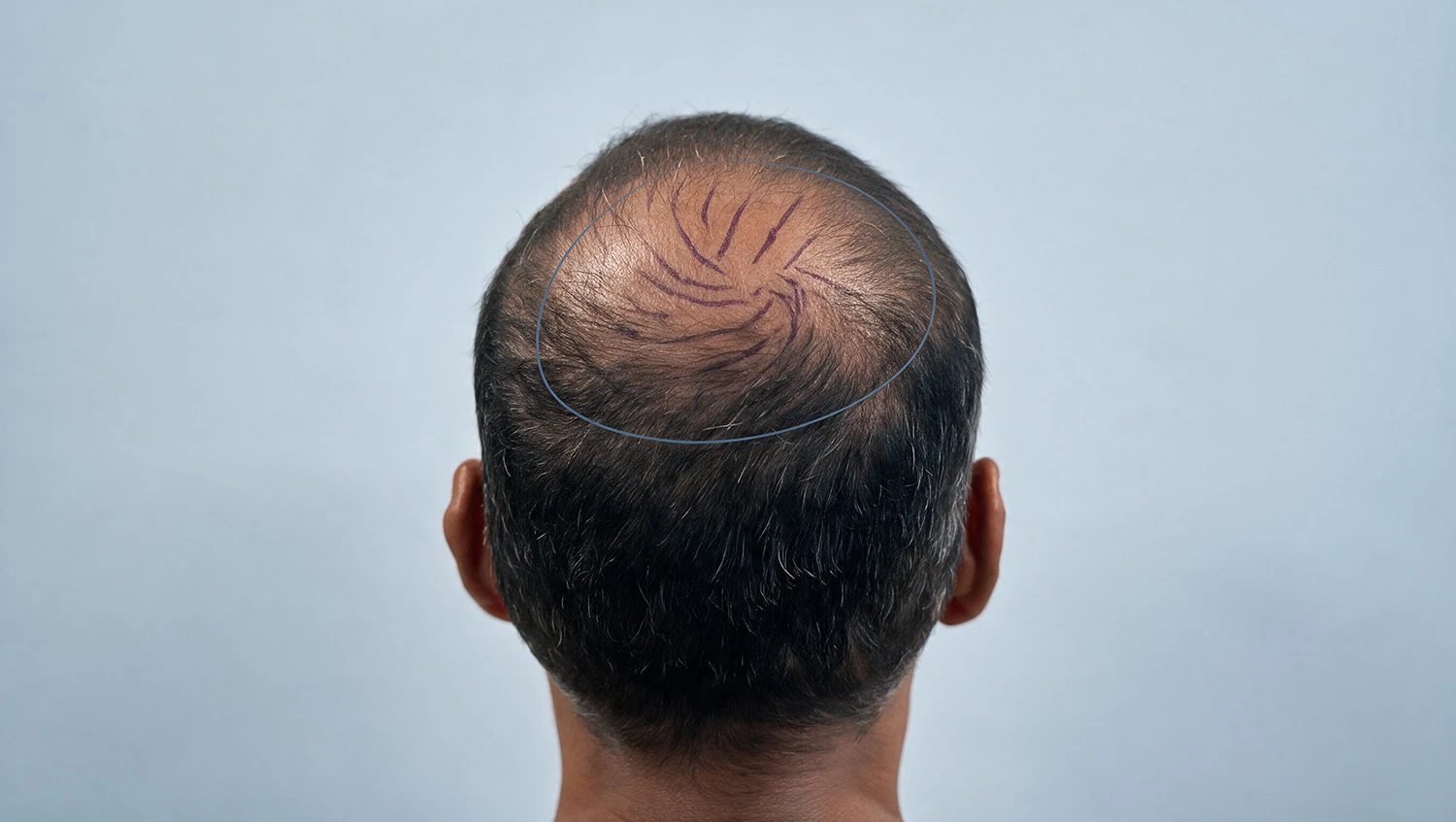
Male pattern baldness (the most common cause)
In most men, a thinning crown is androgenetic alopecia. Hair follicles in genetically sensitive areas react to DHT, a hormone made from testosterone, and produce thinner, shorter hairs with each growth cycle until they stop producing visible hair. The crown is one of the two areas where this typically starts; the other is the temples. On the Norwood scale, crown thinning appears as “Norwood 3 vertex”, and by Norwood 4 the crown is usually a clear bald spot separated from the front by a band of hair.
Some men lose hair at the crown first and keep a strong hairline for years. Others see both happen together. The pattern is inherited, so the way your father or grandfathers lost their hair is often a useful hint.
Alopecia areata
If the bald spot is round or oval, smooth, appeared within a few weeks and has sharp edges, it may be alopecia areata, an autoimmune condition. It can appear anywhere on the scalp, including the back of the head, and often regrows on its own or with treatment. A transplant is not a treatment for active alopecia areata, so this needs to be ruled out before any surgery is considered.
Other look-alikes
- Diffuse shedding after illness, stress or rapid weight loss thins the whole scalp, and is often most noticeable at the crown because the whorl parts the hair there.
- Scalp infections such as fungal infection can cause scaly, itchy patches with broken hairs.
- Traction from tight hairstyles or habits like rubbing the same spot can thin hair locally.
If the area is itchy, scaly, red or painful, see a doctor first; pattern baldness itself causes none of these.
How to tell if your crown is thinning
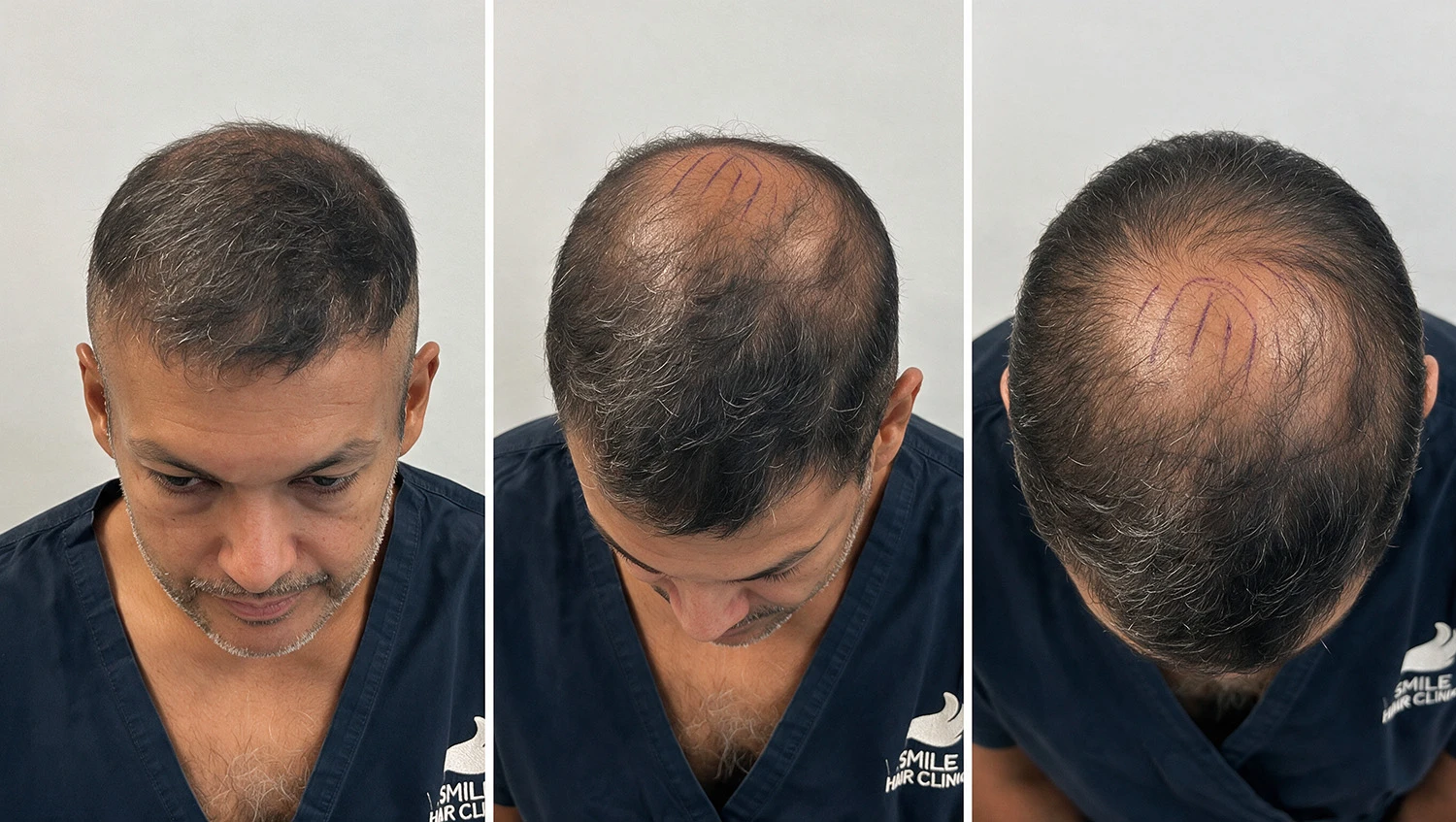
The crown is the one part of your scalp you cannot see in a mirror, which is why many men only notice a bald spot when someone else points it out or a photo catches it.
Signs to look for
- The whorl widens. Every crown has a small natural parting where the hair spirals. In early thinning, that parting gets wider and the scalp shows through more, especially under overhead light or when the hair is wet.
- Finer hairs around the whorl. Hairs around the bald spot become thinner and shorter than the hair on the sides.
- It changes over time. A normal whorl looks the same in photos taken months apart. A thinning crown slowly gets larger.
How to check it yourself
Take a photo of the top of your head from directly above, in the same light every three months, with dry hair and with wet hair. Comparing them over six to twelve months is far more reliable than an occasional look with two mirrors.
How crown balding progresses
Crown loss usually spreads outwards in a circle. In many men it eventually meets the frontal recession, and the bridge of hair between them thins until the front and crown merge into one bald area, which corresponds to Norwood 6. The crown can be a large area by then: in one of our Norwood 5 patients, the crown alone measured close to 100 cm². How fast this happens varies a lot between people, which is why early photos are so valuable.
Treatment options for a bald spot on the crown
For pattern baldness at the crown, treatment follows a clear order: protect the hair that is still there, then decide whether a transplant is worth it.
Medication: where the crown responds best
The crown is the area where medical treatment has the strongest evidence. In the original two-year finasteride trials in 1,553 men, hair was counted in a 5.1 cm² circle of the balding crown: men on finasteride gained on average 107 more hairs than placebo after one year and 138 after two, while men on placebo kept losing hair. In a five-year follow-up of 126 men, crown thinning improved in 89.7% of patients and improved faster and more steadily than the hairline.
Minoxidil is the other established option and is often combined with finasteride. Both need a doctor’s prescription and follow-up, and both work only for as long as they are used.
Scalp treatments
In-clinic treatments can support medication, especially in early thinning or after a transplant. PRP hair treatment uses growth factors from your own blood, while hair mesotherapy and exosome hair therapy deliver active ingredients directly into the scalp. None of them replaces medication for pattern baldness.
Hair transplant for the crown
A transplant can restore coverage at the crown, but it is planned very differently from a hairline.
Why the crown is harder than the hairline
The frontal area has a rich blood supply, and graft survival there is above 90%. At the crown, circulation and anatomy are less favourable, and survival is closer to 70–80%. Packing more grafts into the crown does not fix this: if too many grafts are placed too densely, the success rate drops further. Each area of the scalp needs its own density.
The crown also has a whorl, where hair grows in a spiral. Each graft has to follow that spiral direction and angle, or the result looks unnatural when the hair is short or wet.
Why the front usually comes first
Crown loss tends to keep expanding, and the crown can be a large area. When the donor supply is limited, I prioritise the hairline and mid-scalp, because they frame the face and make the biggest difference to appearance. The crown is often treated with medication first and transplanted later, or in a second session.
In one 30-year-old patient who received 6,700 grafts, the front and mid-scalp were fully restored at twelve months, while the crown was still filling in; we had agreed before surgery that it might need a second session. Crown results also take longer to show: growth there is often delayed compared with the front, and thickening continues after the seventh or eighth month.
How many grafts a crown needs
It depends on the size of the bald spot and the density you want. A small, early crown may need 1,000–1,500 grafts; a large crown at Norwood 5 or 6 can need several thousand on its own. To see how the graft count affects the price, read how hair transplant graft cost is calculated. When scalp donor is not enough for both front and crown, beard and body hair grafts can add coverage, and most crown restorations are performed as a Sapphire FUE hair transplant.
When a crown transplant is not a good idea
- When the crown is still thinning quickly and medication has not been tried.
- When the bald spot is alopecia areata or another active condition.
- When the donor area cannot cover both the front and crown, and the front matters more to you.
Dr. Erdoğan’s Advice: Treat the Crown Early, Transplant It Last
A bald spot on the crown is where early action pays off most. Medication has its best evidence there, and every hair you keep at the crown is one less graft you need later. A transplant can restore the crown, but it is the area where survival rates are lowest, where loss keeps expanding, and where donor grafts compete with the hairline.
The best plan is usually to stabilise the crown first, restore the front if needed, and treat the crown with grafts only when the loss has slowed and the donor area can support it. Before any of that, make sure the bald spot really is pattern baldness and not alopecia areata.
Can Your Crown Be Restored? Start With One Photo From Above
The crown is the hardest area to judge in a mirror, and the hardest to plan for in surgery. A clear photo of your crown from directly above, together with your hairline and donor area, is enough for a first honest assessment: whether medication is still the best option, whether the front should come first, and how many grafts a crown restoration would realistically need. When you are ready to plan, read how a crown hair transplant in Turkey is planned alongside the hairline, compare the cost of a crown and hairline transplant in Turkey, and see what your hair transplant package includes.
Frequently asked questions
Can a bald spot on the crown grow back?
If the follicles are still alive and producing fine hairs, medication can often thicken them again; the crown is where it works best. An area that has been completely bald for years will not regrow with medication and needs a transplant.
Is a thinning crown always male pattern baldness?
No. A round, smooth patch that appears quickly may be alopecia areata, and diffuse shedding can make the crown look thin temporarily. A doctor’s examination tells them apart.
Does a crown hair transplant work?
Yes, but graft survival at the crown is lower than at the front, around 70–80% compared with over 90%, and the result takes longer to mature. Realistic density goals and good planning around the whorl matter more than the number of grafts.
Should I transplant the crown or the hairline first?
In most cases the hairline. It frames the face and benefits most from donor grafts. The crown is usually stabilised with medication first and restored later if the donor area allows.
This article is for information only and does not replace an in-person medical examination.
Sources
- Kaufman KD, et al. Finasteride in the treatment of men with androgenetic alopecia. J Am Acad Dermatol. 1998;39(4 Pt 1):578–589. doi:10.1016/s0190-9622(98)70007-6
- Shin JW, et al. Evaluation of long-term efficacy of finasteride in Korean men with androgenetic alopecia using the basic and specific classification system. J Dermatol. 2019;46(2):139–143. doi:10.1111/1346-8138.14719